


Key takeaways:
- Perimenopause, menopause, and postmenopause are three distinct stages — and each comes with different hormonal changes, symptoms, and health considerations.
- Perimenopause is often the most unpredictable (and certainly longest!) stage, with fluctuating hormones that can affect everything from sleep and mood to periods and brain fog.
- Menopause is a single point in time: You've officially reached it after 12 consecutive months without a period.
- Postmenopause is a rest-of-life stage where symptoms may improve, but protecting bone, heart, brain, and metabolic health becomes increasingly important.
- You don't have to suffer through the transition. Lifestyle changes, hormone therapy, and expert care can make a meaningful difference.
Perimenopause vs. menopause vs. postmenopause can feel like a blur — here's how to tell which stage you're in, what each one actually feels like, and how to get the support you need to feel your best.
The question of “perimenopause vs. menopause” seems to be everywhere these days — TikToks, podcasts, group chats — and somehow all that information has made things even more confusing. If you've found yourself wondering, Wait...am I in perimenopause? Menopause? Something else? you're not alone.
Knowing the difference between perimenopause and menopause is pretty major, and it isn't just about getting the terminology right. This knowledge will also help you understand which symptoms to expect, what treatments may help, and what to watch for as your body changes.
While brain fog, lousy sleep, and mood swings aren't exactly a good time, knowledge is power. This guide will cut through the noise with clear definitions, what each stage actually feels like, and practical clues to help you figure out where you are in the transition.
First, let's get the language right
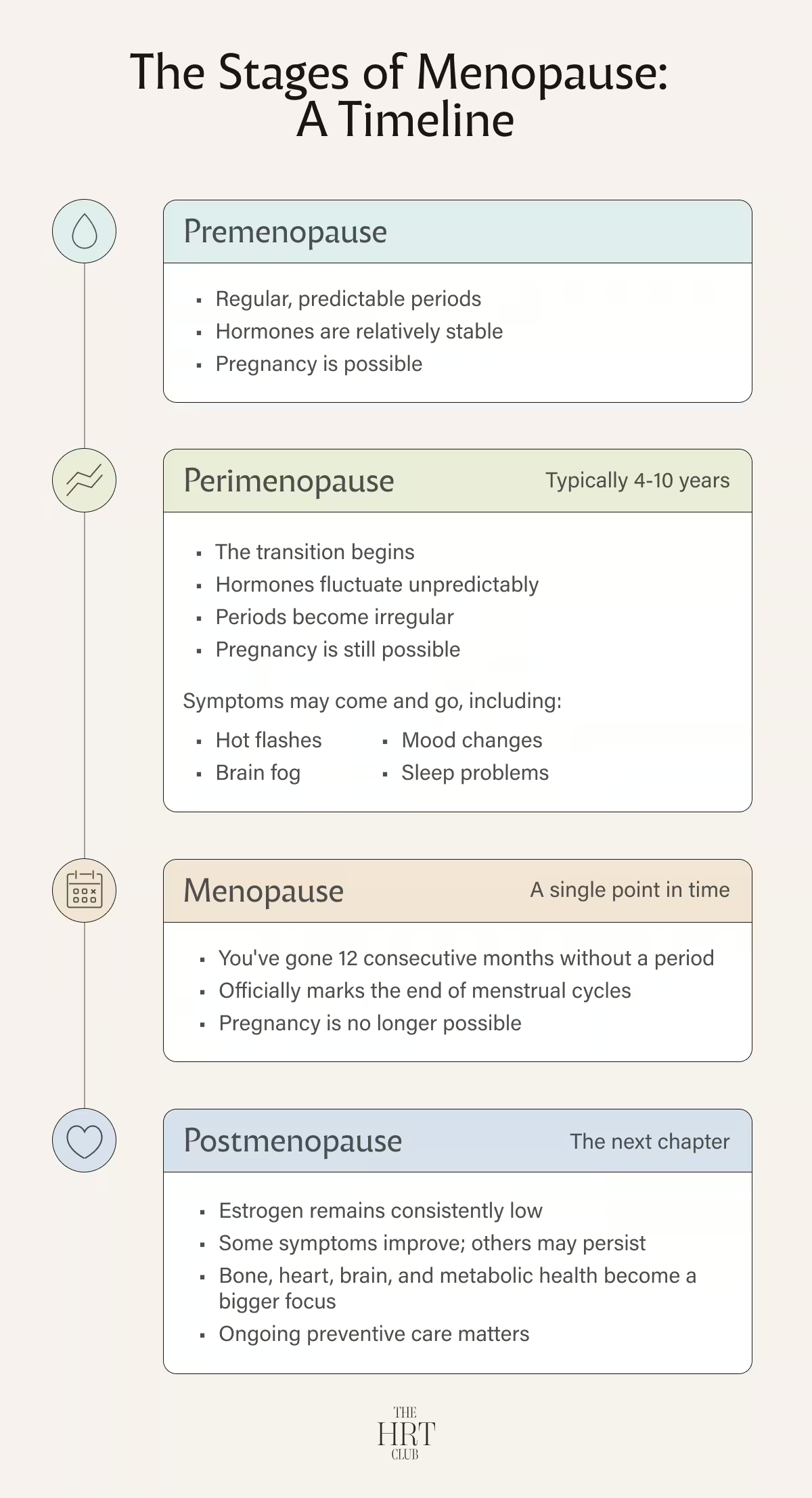
Menopause terminology can be surprisingly confusing. When people say, "I'm going through menopause," they're often misspeaking, since menopause is one moment in time. Medically, there are three distinct stages, according to npj Women’s Health:
- Perimenopause: The years leading up to and around your final period, when hormone levels fluctuate and symptoms like hot flashes, brain fog, mood changes, and irregular periods often begin.
- Menopause: A single point in time, officially reached after 12 consecutive months without a menstrual period.
- Postmenopause: The years after menopause.
Why it matters: Each stage has its own hormonal changes, symptoms, and health considerations. Knowing where you are in the transition can help you better understand your body and your treatment options.
What is perimenopause?
Perimenopause is the transition leading up to menopause, during which ovarian follicle depletion leads to changes in ovarian function and fluctuating estrogen and progesterone production. Here, hormones like estrogen and progesterone become unstable, according to the Journal of Mid-Life Health. Hormone levels don't dip in a straight line, though — they fluctuate unpredictably, which is why symptoms can feel like they're all over the place.
Most people with a uterus enter perimenopause in their mid- to late 40s, per the Office on Women’s Health, though it can begin as early as their 30s. According to Clinical Obstetrics and Gynecology, it lasts about four years on average, but can continue for up to 10 years.
Early perimenopause often brings cycle changes (think: irregular or skipped periods), while later stages are marked by longer gaps between periods (60 days or more) — though everyone's timeline is different.
What is menopause?
Menopause is the point when your periods stop permanently, marking the official end of your reproductive years. But here's the tricky part: “Menopause is diagnosed retroactively, which makes things a bit confusing,” says Tamara De Angelis, LCSW, a licensed psychotherapist with a focus on treating women in the menopause transition. In other words, you'll only know you've reached menopause after you've gone 12 consecutive months without a period.
Unlike perimenopause, which can last for years, menopause is “technically one day,” explains Anna Cabeca, DO, FACOG, triple board-certified OB-GYN.
According to the Journal of Mid-Life Health, most women and other individuals with functioning ovaries reach menopause between ages 45 and 55 (the average in the U.S. is 52). It can also happen earlier naturally, after surgery to remove both ovaries, or following certain cancer treatments, per the Canadian Menopause Society.
After menopause, ovarian estrogen and progesterone production declines markedly, while small amounts of ovarian androgens continue to be produced. So, how does this impact how you feel? Ironically, the symptoms most people associate with "menopause" — like hot flashes and mood swings — often peak during perimenopause. Some women feel relief once hormone fluctuations settle, while others continue to experience symptoms into postmenopause.
What is postmenopause?
Postmenopause begins after menopause — that is, once you've gone 365 days without a period. From that point on, “a woman will remain postmenopausal for the remainder of her life,” says De Angelis. Natural pregnancy is no longer possible, and your ovaries produce very little estrogen or progesterone.
For many women, the roller coaster of perimenopause settles down. But that doesn't always mean symptoms disappear. Hot flashes can continue for an average of nine years after menopause — and for some women, up to 14 years, according to the Office on Women’s Health.
Lower estrogen also brings new long-term health considerations. Vaginal dryness often becomes more noticeable, and the risk of conditions like osteoporosis, heart disease, and stroke increases, per the American College of Obstetricians and Gynecologists. That's why postmenopause isn't the end of the conversation — it's the start of a new phase of health.
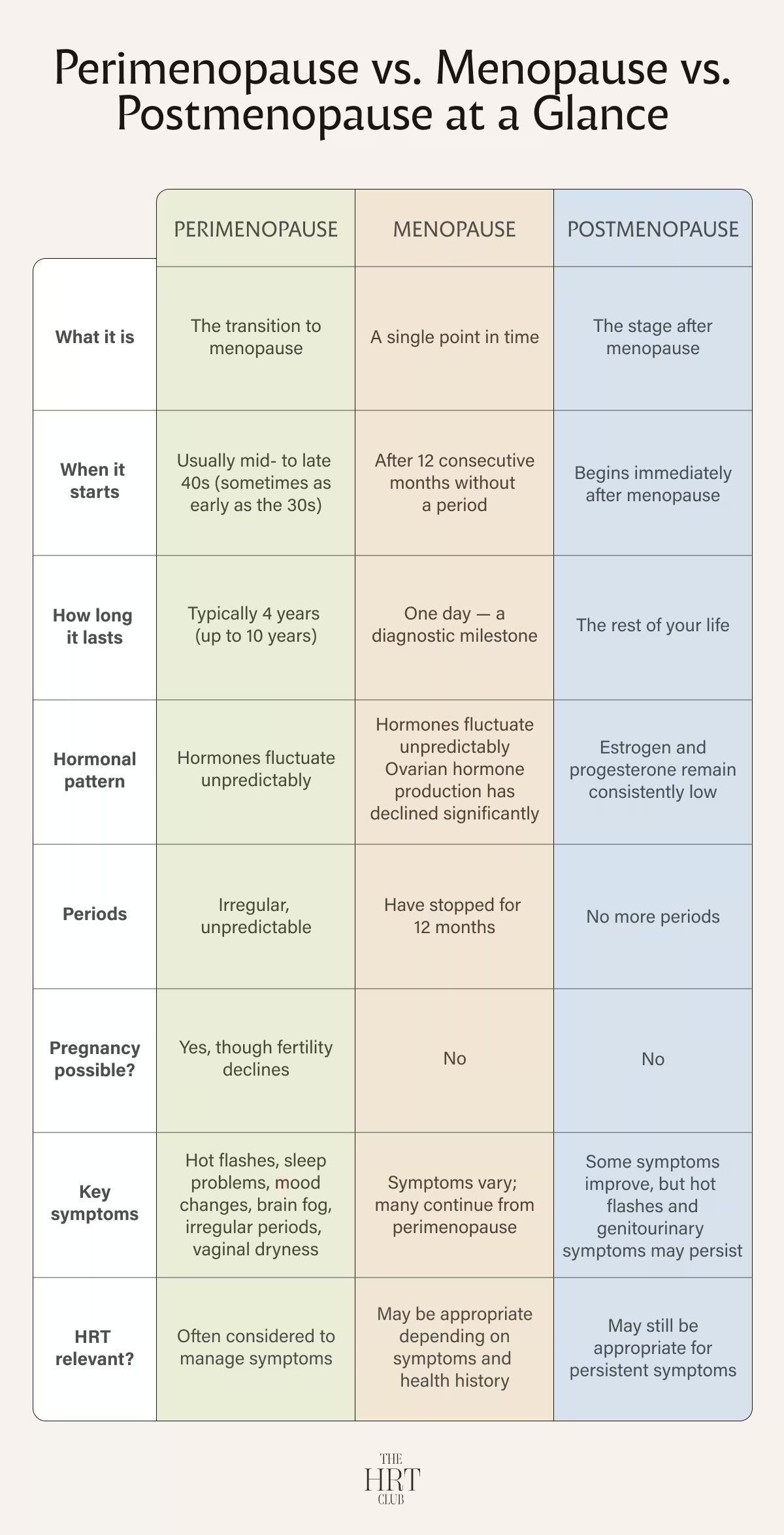
Perimenopause vs. menopause vs. postmenopause: How they compare
What does each stage actually feel like?
The medical definitions are one thing, but what do these stages actually feel like in day-to-day real life?
What perimenopause feels like
In a word: unpredictable. One week you feel like yourself. The next, you're wondering what happened. “Perimenopause can feel like living on a hormonal roller coaster,” says Dr. Cabeca. Many people describe it simply as, "I just don't feel like myself."
Because hormone levels fluctuate from day to day, symptoms can too. “You never know when a hot flash will hit, when you'll sleep poorly, or when your mood or energy will shift,” explains Dr. Cabeca. You might also experience brain fog, fatigue, or irregular periods alongside emotional changes. “During these significant hormonal shifts, a woman’s mood is impacted and may present as mood swings, anxiety, depression, or irritability,” adds De Angelis.
To make matters worse, many perimenopausal people feel blindsided, unprepared, and unsupported by healthcare systems, according to npj Women’s Health. Since perimenopause can begin years before periods become noticeably irregular, it's also easy to miss the connection. Many people don't realize their symptoms are hormone-related and often struggle to find the information and care they need.
What the menopause transition feels like
It's a little anticlimactic. The moment of menopause itself usually doesn't feel dramatic — it's only confirmed after you've gone 12 consecutive months without a period.
Sometimes, the biggest change isn't menopause itself — it's the end of perimenopause's volatility. “For many women, one of the biggest reliefs is simply the return of predictability,” says Dr. Cabeca. “Many women tell me they finally feel like themselves again.” But the emotional experience varies. Some people feel a sense of loss, others feel liberated, and many experience both.
As hormone levels stabilize, symptoms often do too. Hot flashes may become less frequent, sleep can improve, and mood may feel steadier. “That doesn't mean every symptom disappears, but many women experience a renewed sense of stability and confidence,” says Dr. Cabeca.
What postmenopause feels like
For many, postmenopause feels more stable than perimenopause. “The hormone levels settle, and a new normal emerges,” says De Angelis. That said, some women continue to experience issues like hot flashes, vaginal dryness, urinary symptoms, or painful sex.
While day-to-day symptoms often improve, long-term health risks become more important. Lower estrogen contributes to accelerated bone loss and is associated with changes in cardiovascular and metabolic health, says Amy G. Cantor, MD, a professor in the School of Medicine at Oregon Health & Science University. The relationship between menopause and cognitive health is more complex and influenced by multiple factors.
“Too many people think menopause is the finish line,” says Dr. Cabeca. “In reality, it's the beginning of an entirely new chapter that deserves just as much attention.” She adds, “Postmenopause isn't the time to stop paying attention...Your bones…heart…muscles, metabolism, brain, and hormones all deserve ongoing care so you can remain vibrant for decades to come. With the right support, it can be one of the healthiest and most fulfilling seasons of your life.”
Common misconceptions about perimenopause and menopause
There's no shortage of menopause myths, and some of them can keep people from getting the care and support they deserve. Let's separate fact from fiction.
Myth: Perimenopause always starts in your late 40s.
Not necessarily. While many people enter perimenopause in their mid- to late 40s, it can begin in your 30s. Research shows many women ages 30-45 already experience perimenopausal symptoms, per npj Women’s Health.
Myth: HRT is only for severe symptoms.
Not true. “Every woman has symptoms that impact her life in a different way,” says Shannon Scott Schellhammer, MD. “The question isn't, ‘Am I suffering enough?’ It's, ‘What does my body need to thrive?’” adds Dr. Cabeca.
Myth: Postmenopause means the hard part is over.
“Actually, the work simply changes,” says Dr. Cabeca. Hormone swings settle, but bone, heart, muscle, and metabolic health become bigger priorities. About 25 % of women also continue having hot flashes for years after menopause, adds Dr. Cantor.
Additionally, menopause can bring identity shifts and changes in relationships that deserve attention, says De Angelis.
Myth: You can't enjoy sex after menopause.
“Declining estrogen can contribute to vaginal dryness, discomfort, reduced elasticity, and changes in sensation … but these changes are treatable,” says Dr. Cabeca. For example, vaginal estrogen can help maintain healthy vaginal tissue by improving lubrication, balancing vaginal pH, and lowering UTI risk, says Dr. Cantor.
Lubricants, moisturizers, pelvic floor therapy, exercise, and — when appropriate — HRT can also help restore comfort, pleasure, and sexual health, adds Dr. Cabeca.
Myth: Hormone replacement therapy causes breast cancer.
“The relationship between menopausal hormone therapy and breast cancer is both controversial and complicated,” says Dr. Cantor.
Older studies of synthetic hormones found increased risk in some women, but newer research suggests that different formulations, such as micronized progesterone, may have a different breast cancer risk profile, says Dr. Cabeca, although long-term comparative evidence remains limited. While the FDA has announced plans to update certain boxed warning language for menopausal hormone therapy products, current product labeling and prescribing information may still include safety warnings. “Your personal health history, genetics, age, timing, hormone type, dose, and duration of therapy all matter. This is a conversation to have with a knowledgeable healthcare provider — not a decision to make based on fear or outdated information.”
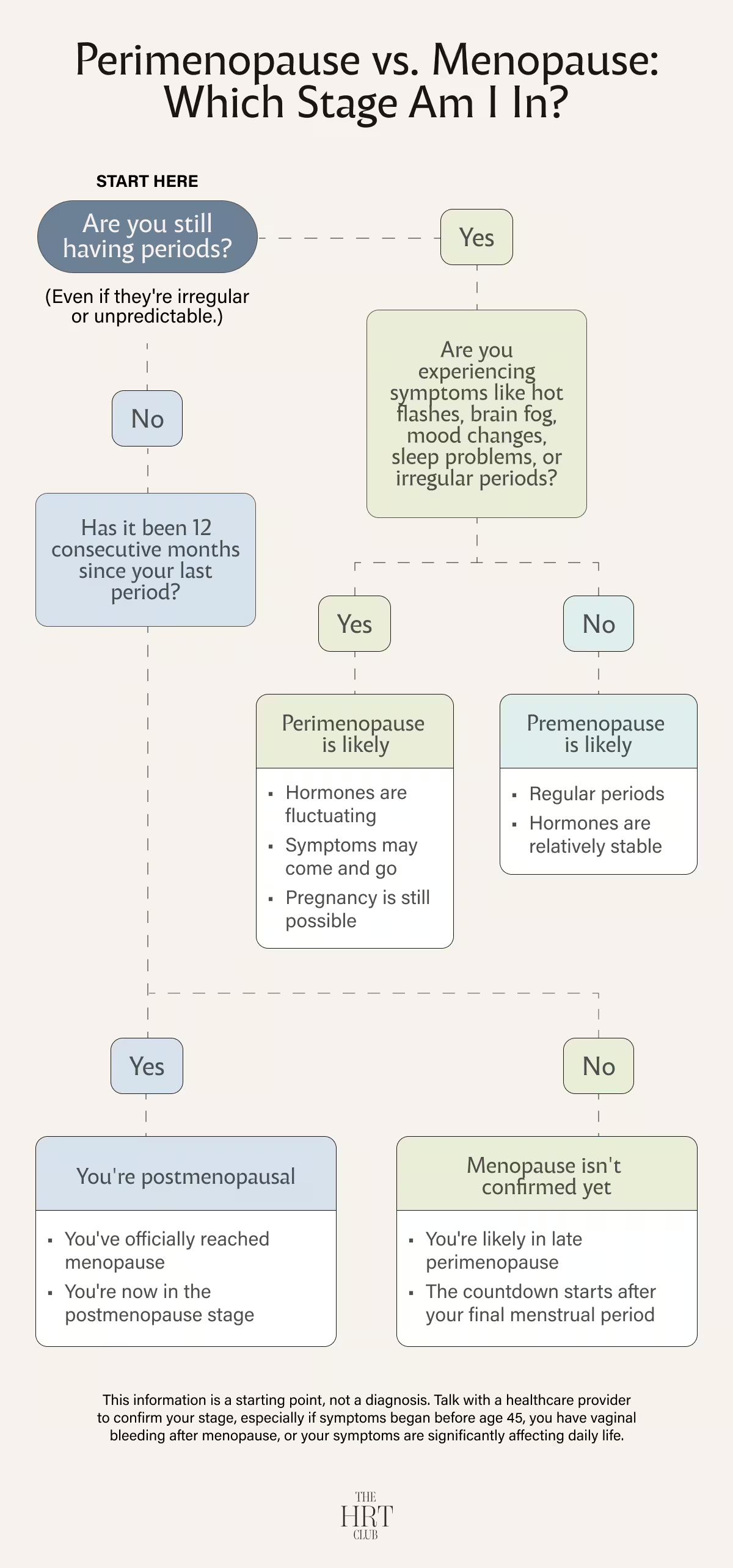
How to tell which stage you're in
Your menstrual cycle is usually the biggest clue, says Dr. Schellhammer. “Clinically, we use the STRAW+10 staging system...to understand where a woman is in the transition,” adds Dr. Cantor.
- Early perimenopause: Your cycle becomes less predictable, with periods shifting by seven days or more from your usual pattern.
- Late perimenopause: 60 days or more between periods, when hot flashes and other vasomotor symptoms often peak.
After a full year without a period, you've officially reached menopause. Blood tests that measure follicle-stimulating hormone (FSH) can sometimes help diagnose. FSH testing is generally not recommended for routine diagnosis in people over age 45 because “hormone levels fluctuate significantly during perimenopause, so a single lab test rarely tells the whole story,” says Dr. Cabeca, although the test may be useful in selected clinical situations. “Your symptoms, menstrual pattern, and overall clinical picture remain the most valuable clues.”
When to talk to a provider
Seek prompt evaluation for heavy menstrual bleeding, bleeding after menopause, or symptoms that significantly affect quality of life. That includes irregular periods, hot flashes, sleep problems, mood changes, anxiety, fatigue, brain fog, low libido, or unexplained weight gain.
If you're postmenopausal, any vaginal bleeding is abnormal and should be evaluated promptly, according to the Office on Women’s Health.
Keep in mind that certain medical conditions — including thyroid disorders, iron deficiency, and primary ovarian insufficiency — can overlap or mimic menopause symptoms, so an accurate diagnosis by a qualified clinician matters, says Dr. Cantor. De Angelis also recommends tracking your symptoms and writing down questions before your appointment, especially if talking with your doctor feels overwhelming.
You don't have to wait until symptoms become disruptive — or even have symptoms at all. If you're curious about hormone replacement therapy (HRT) or want to optimize your health during and after menopause, it's worth starting the conversation early. “Don't wait until you're suffering,” says Dr. Cabeca. “Early intervention often makes the transition much smoother.”
Callout box: If you're navigating perimenopause, menopause, or postmenopause and want support, The HRT Club is a helpful place to start, whether you're looking to understand your options, connect with a provider, or fill an existing prescription for less. Learn more or sign up for a free membership.
The bottom line
Understanding the difference between perimenopause and menopause gives you a roadmap for what's happening in your body and how to support your health through each stage, including postmenopause.
As Dr. Cabeca puts it, menopause “is an opportunity to reassess, optimize your health, redefine your priorities, and create an even more meaningful next chapter.”
Whether you're just noticing symptoms or looking for better treatment options, you don't have to navigate this transition alone.
FAQ
What is the average age for perimenopause?
Perimenopause doesn't follow a strict timeline. Many people start noticing changes in their 40s, while others begin in their 30s. The transition usually lasts several years and can stretch to a decade.
What is the difference between perimenopause and premenopause?
Confused about perimenopause vs. premenopause? Although the terms are often used interchangeably, they're different. Premenopause refers to your fertile years before hormonal changes begin, while perimenopause marks the transition to menopause, when symptoms and cycle changes start.
Which is worse: perimenopause or menopause?
There's no universal "harder" stage. Some women find the unpredictability of perimenopause most challenging, while others struggle more after menopause. Each stage brings different symptoms, health considerations, and treatment needs, so the experience is highly individual.
About Author