

Key takeaways:
- Testosterone isn’t just a “male hormone.” It actually plays a role in everyone’s health, regardless of gender.
- For people who menstruate, potential benefits of healthy testosterone levels include less fatigue, a healthy sex drive, and less irritability.
- Continue reading to learn about the potential benefits of testosterone for women, what rumored effects lack clinical backing, and when testosterone replacement therapy for women is a good idea.
If you read the title and thought, “Wait a minute, isn’t testosterone a male hormone?” you’re not alone. Testosterone is often typecaste as THE male sex hormone, but it’s actually present in everyone, regardless of gender. In fact, women produce three times more testosterone than estrogen in their 20s, according to the British Journal of General Practice.
That, of course, leads to the question “what does testosterone do for women?” Turns out, there are many benefits of testosterone for women, such as improved mood, a healthy sex drive, and less fatigue.
But testosterone is not a standalone act that can solve every health problem out there. Here’s what you can realistically expect from this hormone, including what benefits are backed by clinical evidence, what remains uncertain, and who may benefit from testosterone replacement therapy (TRT).
What does testosterone do in women's bodies?
“Many people are surprised to learn that testosterone is actually the most abundant sex hormone in the female body,” says Bruce R. Dorr, M.D., F.A.C.O.G, F.P.M.R.S., a board-certified OBGYN in Colorado.
But what exactly does testosterone do for people who menstruate? This hormone binds to androgen receptors that deliver cues that play a role in various physiological processes. You can think of testosterone as the first domino in a set. Once it “knocks down” the receptor, a chain reaction of dominos (aka biological processes) fall too.
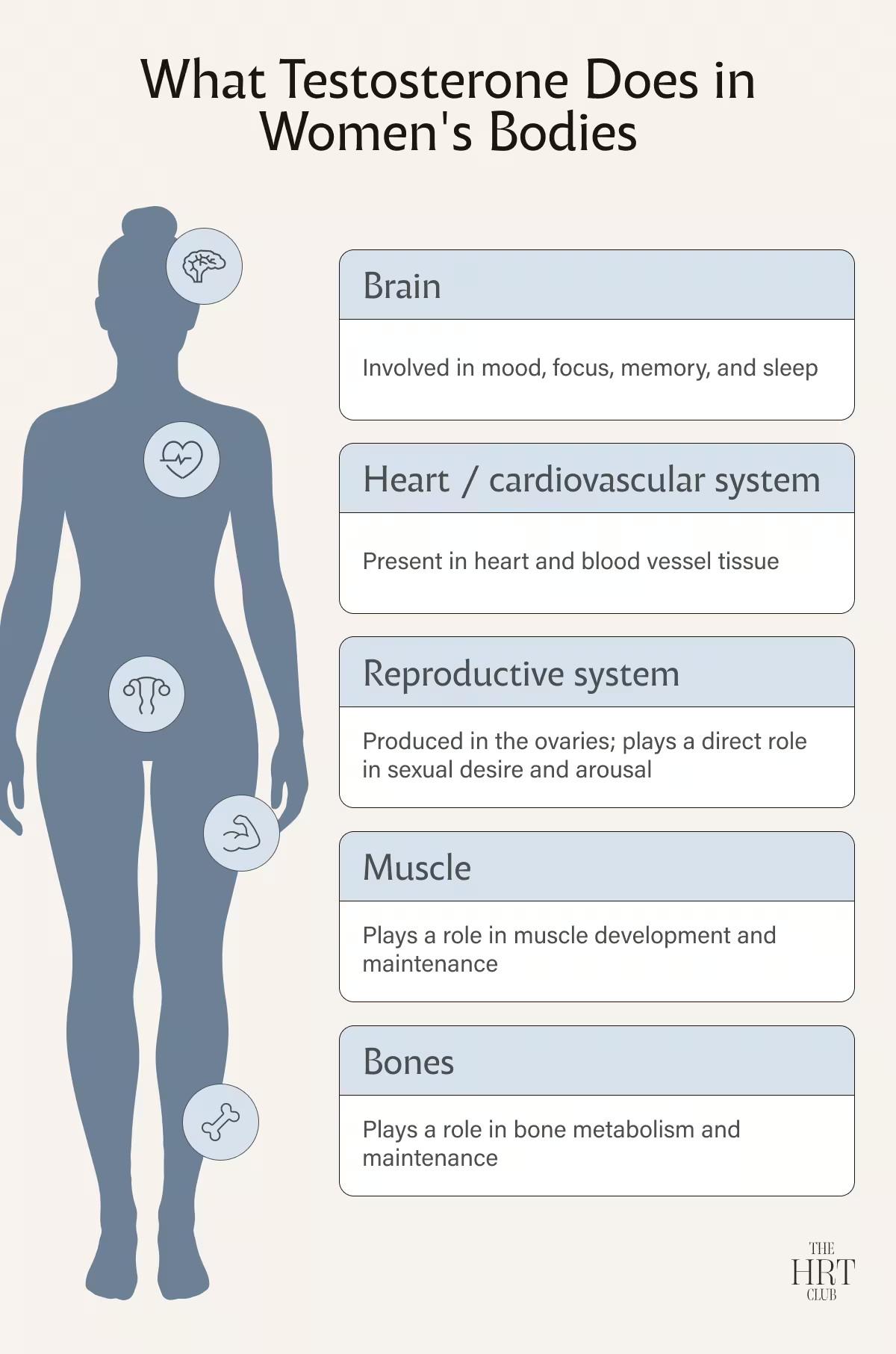
These processes are essential for many aspects of wellbeing. A 2025 review in Cureus and 2022 review in Expert Review of Endocrinology & Metabolism outline what testosterone does in different parts of the body:
- Brain Health: Plays a role in mood, cognitive performance, and low levels of testosterone are linked to anxiety, depression, and irritability
- Muscles: Supports muscle development and maintenance, though evidence doesn’t suggest that testosterone therapy increases muscle mass in women.
- Bone: May improve bone health, but evidence is mixed on if this benefit applies to men or anyone, regardless of gender
- Heart Health: Present in heart and blood vessel tissue, though the role testosterone plays in women is still being researched
- Sexual Health: Supports a healthy sex drive
Androgen receptors are also found in skin cells, joints, and the digestive tract, among other parts of the body, says Dr. Dorr. However, researchers are still exploring the exact role these receptors play in these body parts.
How do testosterone levels change with age?
“As we age, the amount of estrogen and testosterone that we produce lessens,” says Dr. Dorr, “This subsequently leads to a loss of quality of life and function throughout the body.” Per a 2021 review in Mayo Clinic Proceedings, testosterone levels start to decline when someone is in their 30s. Men lose about 1-2% per year, but less research has been done on what the decline looks like for women.
And that 1-2% stat is just an average, since many factors influence the rate of change. “For some, the drop is accelerated by factors such as stress, trauma, surgery, pregnancy, or genetics,” says Dr. Dorr, “Any of these factors can accelerate the loss of testosterone, leading to a wide range of symptoms.”
One factor that doesn’t influence testosterone levels? Natural menopause. Per a 2025 report in The Lancet, the decrease typically starts before someone reaches perimenopause. While levels continue to drop as we age, they don’t appear to be affected by menopause itself.
What are the benefits of testosterone therapy for women (and what does the evidence actually say)?
Now that we’ve established that testosterone is naturally present, regardless of gender, let’s turn to testosterone replacement therapy (or TRT for short). TRT is a prescribed treatment to replace low testosterone. It’s FDA-approved for men only, but healthcare providers may prescribe it off-label for women.
And what are the benefits of a female taking testosterone? The jury is still out, though there are at least a few established effects and others that are actively under investigation.
What the evidence supports
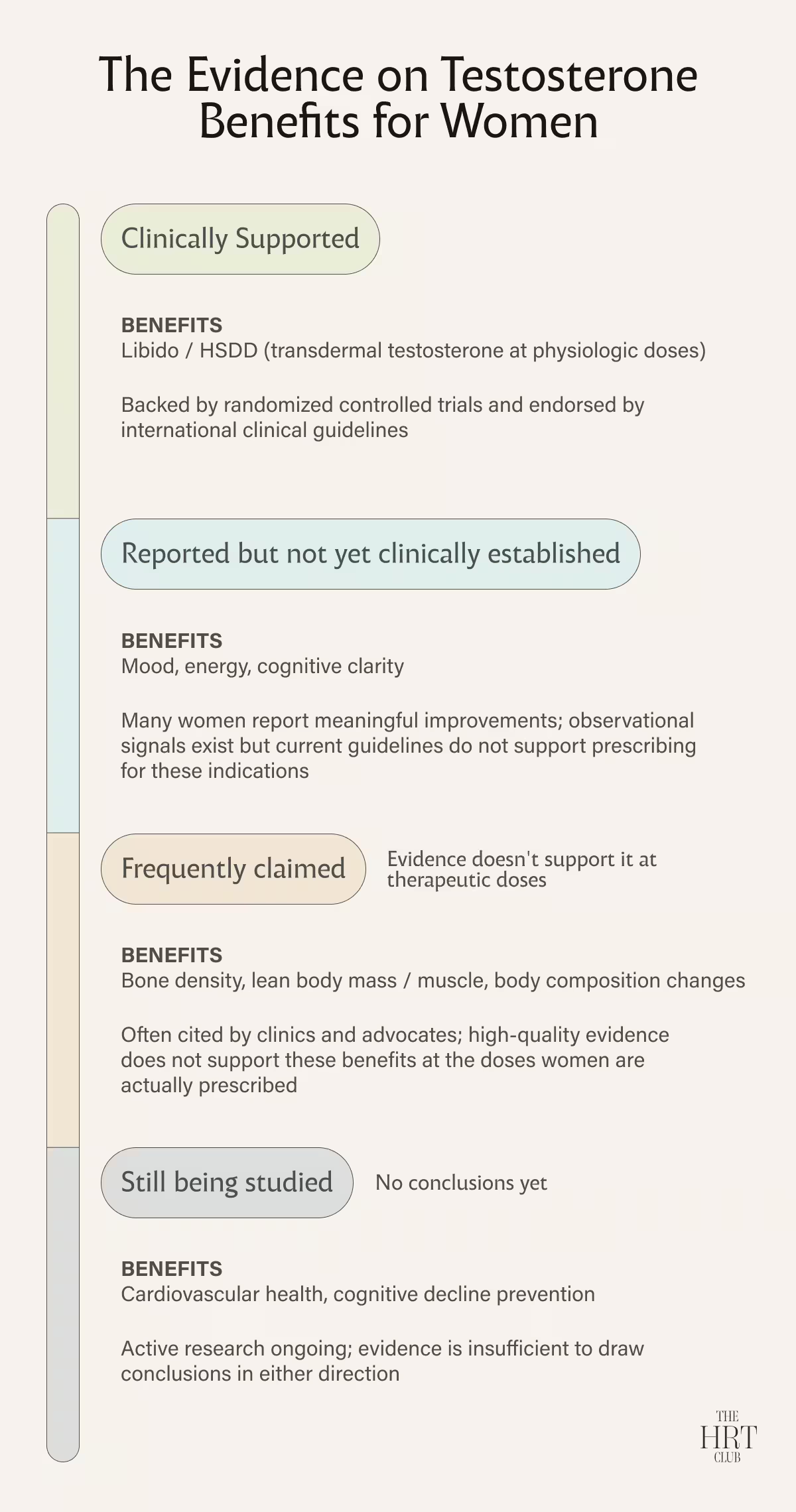
Perhaps the most established benefit of TRT is a boost in libido for women in midlife. In 2019, a Global Consensus Panel made up of members from the International Menopause Society and the Endocrine Society analyzed the available evidence for TRT in women. The panel recommended testosterone therapy for women (at lower doses) for one purpose: to treat hypoactive sexual desire disorder (HSDD) in postmenopausal women.
HSDD is when someone experiences an ongoing lack of interest in sex. It is the most common sexual dysfunction in women, especially among those who have already undergone menopause, per a 2026 review in Menopause.
A 2021 review in the Journal of Women’s Health further supported that when TRT is used a low dosages and in a transdermal form (aka when it’s applied to the skin as a gel or patch), there were no adverse effects in the reviewed studies, and it was highly effective at restoring postmenopausal study participants’ sex drives.
What women commonly report, but evidence doesn't yet fully support
2019 was over seven years ago, and there hasn’t been a more recent consensus panel. However, since then smaller scale studies and anecdotal evidence suggests TRT may offer other benefits.
Dr. Dorr reports that his patients often discuss improvements in mood, including less anxiety and irritability, higher energy levels, cognition changes, and body composition changes from TRT.
Here’s what the limited evidence says on each:
- Mood: In a small cohort study published in the Archives of Women’s Mental Health, 47% of women using testosterone gel during menopause reported an improvement in mood.
- Energy: A 2022 review in the Journal of Personalized Medicine suggests women may see an energy boost or less fatigue from TRT, though the review itself cautions that the evidence here is limited.
- Cognition: A 2024 observational study in Biology of Sex Differences found that participants between the ages 55-90 who had higher levels of testosterone often had better cognitive performance, regardless of gender.
Where the evidence points against common claims
Some patients and prescribing providers also report improvements in bone density and lean body mass. A 2022 survey published in the International Journal of Endocrinology noted that evidence on TRT and bone density is mixed, though their survey of over 1,000 postmenopausal women found an association between bone density and higher testosterone levels.
Just remember that correlation does not equal causation, and the claim that TRT increases bone density in women is still controversial.
The evidence is even more of a question mark when it comes to muscle. Numerous studies, such as a 2025 analysis in Frontiers in Physiology, report a link between high levels of testosterone and more muscle mass in men. Those same results haven’t been found in women. Even that 2025 analysis said that while men with higher levels of testosterone had more muscle mass, that didn’t equate to more strength.
Research is ongoing into other benefits, such as if TRT can improve heart health or metabolism. At this time, however, no conclusions can be drawn about these possible benefits.
How testosterone and estrogen work together
Testosterone and estrogen aren’t in competition with one another; one isn’t “better” than the other. Instead, the two are teammates. “Testosterone and estrogen are deeply interconnected,” explains Dr. Dorr, “The two are structurally similar steroid molecules and can produce overlapping symptoms when levels are either too high or too low.”
These overlapping symptoms are why a healthcare provider looks at both when assessing hormonal health. It also means that in some cases, estrogen-based HRT and TRT together is the appropriate hormonal treatment—though that’s a decision for a prescribing healthcare provider to make.
Additionally, some cells can convert testosterone into a type of estrogen, and the emphasis on might is intentional. A 2023 study in Metabolism Open supports this theory, but this research, like many others on the relationship between these two hormones, focused on male participants.
Who may benefit from testosterone therapy?
Testosterone therapy is a prescription medication, meaning a healthcare provider assesses if you’re a good candidate before you can access treatment. To figure out if you’re a good candidate, you can make an appointment with a specialist who is licences to prescribe testosterone. That could be someone you already work with, or you can use a membership platform, like The HRT Club, that offers a directory of hormonal health experts. Testosterone is not FDA approved for those assigned as female at birth but is available for off- label use.
Signs someone might be a good candidate for testosterone therapy are:
- They are postmenopausal with HSDD and haven’t responded to estrogen-based therapy alone.
- Appropriate lab work and clinical assessment suggest low testosterone levels.
- They have experienced a sudden drop in testosterone, such as from a oophorectomy (a surgical removal of the ovaries, which is where a large portion of testosterone is produced).
Why is testosterone therapy for women still complicated?
Despite the growing evidence of testosterone’s benefits for women, there are over 30 FDA-approved testosterone therapies for men…and none for women. This reinforces the mistaken notion that testosterone is just a male hormone. Worse yet, this regulatory gap reflects a broader lack of research on testosterone for women; most clinical trials on TRT only include male participants.
“The truth,” says Dr. Dorr, “is that women also need testosterone, and men actually need estrogen, just at different doses and levels.”
Some international markets take this into account. Testosterone therapy is licensed for use in women in England and Australia, for example, but not FDA-approved in the U.S. TRT is also used in the United States as an off-label prescription for women, which is when a healthcare provider prescribes a treatment for a different use than what the FDA approved it for.
What does testosterone therapy actually involve?
Hormone replacement therapy is a form of personalized care, meaning it may look a little different for everyone. While experiences differ from person to person, Dr. Dorr recommends taking the time to understand the various delivery options, strengths, and processes.
For TRT specifically, delivery methods include:
- Transdermal creams or gels: When testosterone is applied directly to the skin as a gel or cream.
- Injections: A form where someone injects testosterone intramuscularly or subcutaneously.
- Pellets: This method is less established. It’s when a tiny implant with testosterone is inserted into the skin.
- Oral capsule: When someone swallows a pill containing testosterone.
The prescribing healthcare provider will determine the appropriate delivery method and dose depending on a patient’s needs. That dose is usually lower for people who menstruate, regardless of the delivery form.
The healthcare provider can also adjust treatment as needed and answer any questions during your hormonal health journey. “Seek out a provider who is knowledgeable, takes the time to educate you, and can help you manage your symptoms in a way that supports long-term quality of life and longevity,” advises Dr. Dorr.
Similarly, you want to work with a pharmacy or membership platform that provides access to multiple delivery methods and understands that hormonal therapies should be personalized and accessible. The HRT Club is not only committed to offering a range of hormonal therapies and providing access to providers; they also help members fill prescriptions at an affordable price.
The bottom line
Testosterone is an essential hormone, regardless of gender. For women specifically, testosterone therapy may help improve the sex drive of postmenopausal women. This is not an FDA-approved indication but can be used off-label by your provider. Other possible benefits are emerging too as more researchers study testosterone for women.
If you are curious about whether testosterone therapy is right for you, the next step is to have a conversation with a healthcare provider. For those who have a prescription, The HRT Club offers access to personalized, affordable hormone therapy. Members without a prescription may also use our directory of hormonal health experts.
FAQ
What are signs of low testosterone in women?
The signs of low testosterone in women include unexplained fatigue, mood changes, and decreased sex drive. It’s possible that low testosterone causes other symptoms, such as changes in cognition or vasomotor symptoms (i.e. hot flashes), but there’s not enough research to confirm these symptoms.
Will testosterone make a woman lose weight?
No, testosterone therapy is not a weight loss treatment.
Is testosterone safe for women?
Testosterone is generally considered safe for people who menstruate when taken in low doses and monitored by a healthcare provider. International guidelines recommend it to treat hypoactive sexual desire disorder in postmenopausal women, though emerging research suggests it may have other benefits too.
About Author