.png)
.jpg)




Key takeaways:
- Estradiol, in a nutshell, is a type of estrogen, your body’s most potent form during your reproductive years, though that changes to estrone in postmenopause.
- Your provider may order estradiol testing, but what’s considered “normal” depends on where you are in your menstrual cycle and/or your life stage.
- Ranges vary widely based on these factors, and labs also use varying ranges.
- This article provides some guidance on what your results might mean.
Estradiol (E2) is the strongest and most abundant form of estrogen in your body during your reproductive years, so it is the one most talked about in relation to your menstrual cycle or the menopause transition. Estrone becomes the predominant circulating estrogen after menopause, while estradiol remains the most biologically potent estrogen.
But this hormone is a bit like the domestic thriller page-turner on your nightstand: shrouded in mystery. Twists and turns make for a fun novel, but when it comes to your hormones, you might be on the hunt for clear answers.
Maybe your healthcare provider ordered an estradiol test and you’re looking at your results, wondering what they mean. Annoyingly, while a single estradiol level may provide useful information in certain clinical situations, by itself it often does not provide a complete picture of hormonal status.
The bigger picture matters because estradiol levels change, depending on where you’re at in your menstrual cycle and where you are in life. Even during perimenopause, the years leading up to menopause, which occurs when you’ve had an absence of a period for a full year, estradiol levels can be erratic. Complicating matters is that the normal reference ranges for estradiol can vary by laboratory.
This doesn’t mean you have to be in the dark about your hormones, though. In this article, we cover normal estradiol levels by age, what high and low levels might mean, and more.
What Is Estradiol and Why Do Levels Matter?
Estradiol is the most potent and abundant form of estrogen in your body during your reproductive years. It is mostly produced in your ovaries’ granulosa cells. You might think about estradiol as a hormone that’s only related to your menstrual cycle and fertility. But estradiol does so much more.
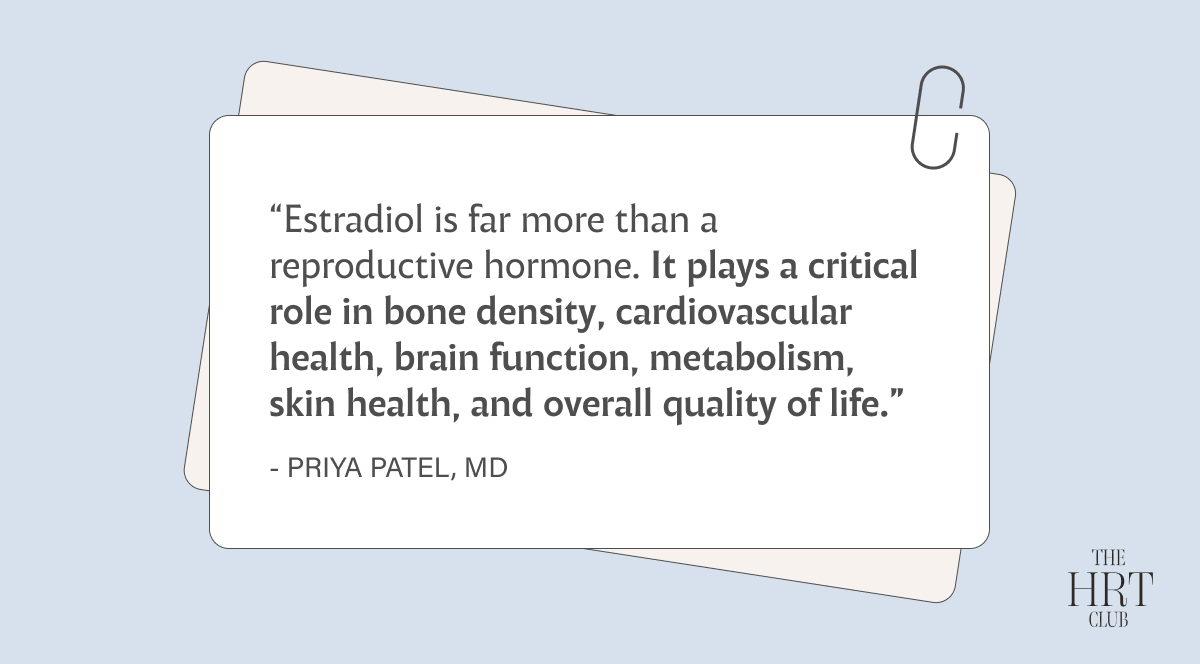
“Estradiol is far more than a reproductive hormone,” says Priya Patel, MD, an OB/GYN and founder of FeminologyMD. “It plays a critical role in bone density, cardiovascular health, brain function, metabolism, skin health, and overall quality of life.”
As you can see, with all its functions, estradiol matters for overall long-term health. But what constitutes a “normal” level depends on where you are in your menstrual cycle and what stage of life you’re in. In your reproductive years, estradiol levels fluctuate based on the phases of your menstrual cycle, with a peak near ovulation and another slight rise and fall during the luteal phase.
Estradiol levels also change as you enter the menopause transition, a time when this hormone can behave somewhat erratically before stabilizing in postmenopause, according to research in the journal Menopause.
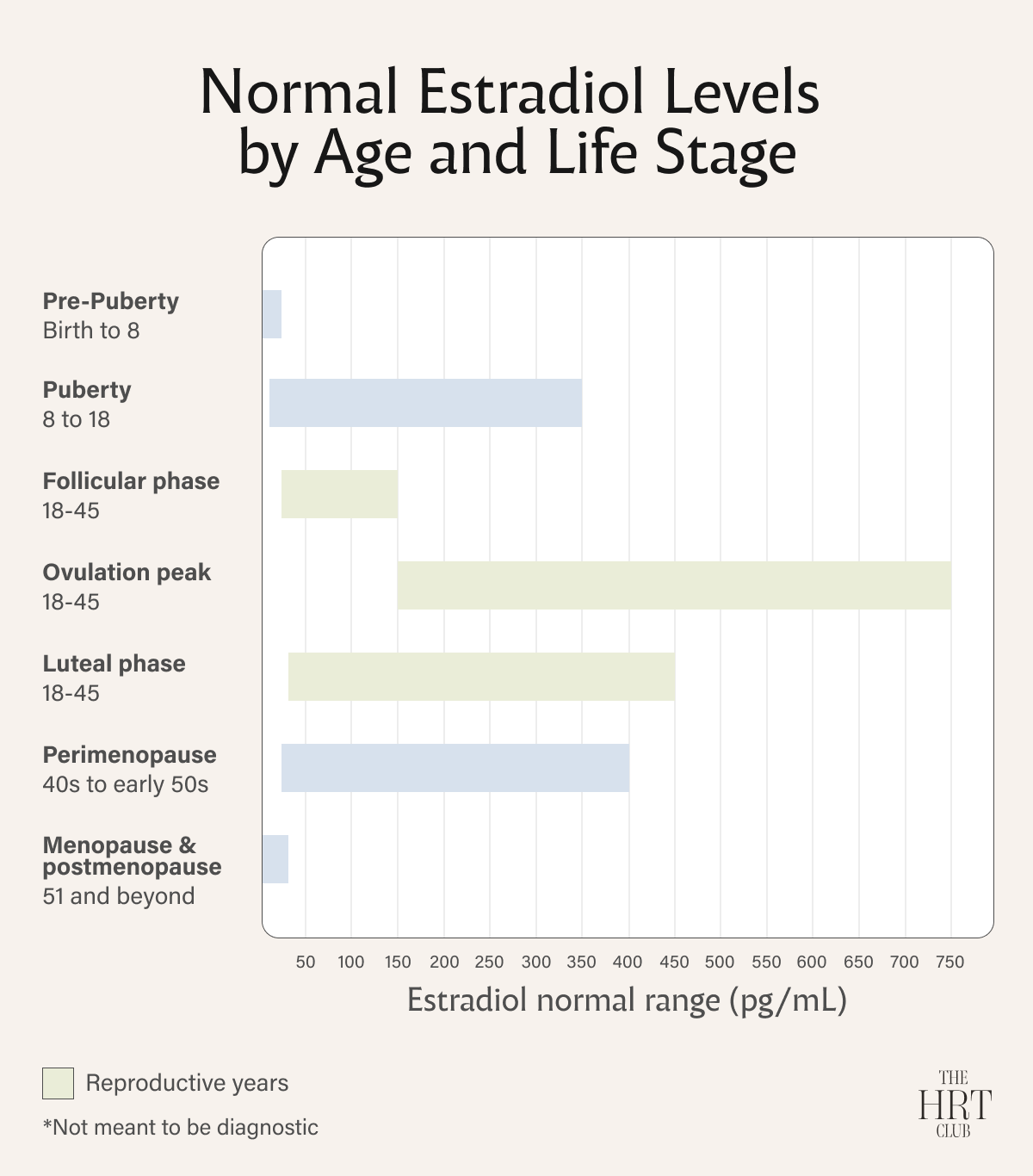
Normal Estradiol Levels by Age and Life Stage
The following table shows an aggregate of reference ranges for normal estradiol levels in females across several United States laboratories, based on your life stage and menstrual cycle phase.
We provide more context for estradiol levels in women by life stage and cycle phase below the table. This table is not meant to diagnose low or high estradiol on its own; it’s just here to offer general ranges.
For your individual result, be sure to compare with the estradiol ranges for the specific lab that interpreted your test, rather than a generic estradiol levels chart. Most labs use picograms per milliliter (pg/mL), though some use picomoles per liter (pmol/L).
Conversion:
- 1 pg/mL = 3.671 pmol/L
- 1 pmol/L = 0.2724 pg/mL
Now let’s explore what else you need to know about normal female hormone levels by age and stage, specifically estradiol.
Life stages:
- Pre-puberty: Estradiol remains low prior to puberty but begins to rise as the ovaries mature.
- Puberty: Experts characterize puberty by Tanner Staging (aka Sexual Maturity Rating). Estradiol varies widely across Tanner Staging—basically from when breast buds show up to their full development—and across the menstrual cycle.
- Reproductive years: Estradiol levels vary across menstrual cycle phases.
- Follicular phase: Estradiol is lower during this early phase of the menstrual cycle, but it increases toward ovulation (around mid-cycle).
- Ovulation peak (mid-cycle): Estradiol peaks just before ovulation.
- Luteal phase: Estradiol declines somewhat just after ovulation but increases slightly again during the mid-luteal phase before declining again about the time of your period.
- Perimenopause: Estradiol levels become highly unpredictable in the years leading up to menopause as your ovaries’ supply of eggs declines. A one-off estradiol reading might match postmenopausal levels while another might match that of your reproductive years. For this reason, healthcare providers typically diagnose perimenopause based primarily on menstrual history and symptoms rather than hormone levels alone. (See below for more on why estradiol fluctuates so much in perimenopause.)
- Menopause and postmenopause: Estradiol production declines substantially by menopause, reducing by more than half when compared to your reproductive years, according to research in the Journal of Clinical Endocrinology & Metabolism. This hormone stabilizes in postmenopause, so you will no longer have such highly variable levels.
What Do Low Estradiol Levels Mean?
If your estradiol level shows up on the low side, what does it mean for your health?
Of course, a low level can indicate that you are getting closer to menopause. But if you are still in your reproductive years and still have one or both of your ovaries, then you might be looking at a different story.
You might experience a low level at certain times during your cycle, including the early follicular phase and the late luteal phase. These are just natural dips in the typical estradiol roller coaster across cycle phases.
But if multiple tests show that you have a low level across various phases, something else might be going on. Here are a few considerations:
Possible causes of low estradiol, not related to menopause:
- Autoimmune disorders
- Certain medications
- Functional hypothalamic amenorrhea (FHA)
- Genetic conditions
- Hormonal contraception
- Hyperprolactinemia
- Hypothalamic disorders
- Pituitary disorders
- Polycystic ovary syndrome (PCOS) or polycystic ovary syndrome (PCOS), recently proposed by some organizations to be renamed polyendocrine metabolic ovarian syndrome (PMOS)
- Breastfeeding (lactation)
- Primary ovarian insufficiency (POI)
- Severe chronic illness
- Stress (ongoing)
- Thyroid disorders
- Ovarian surgery or injury
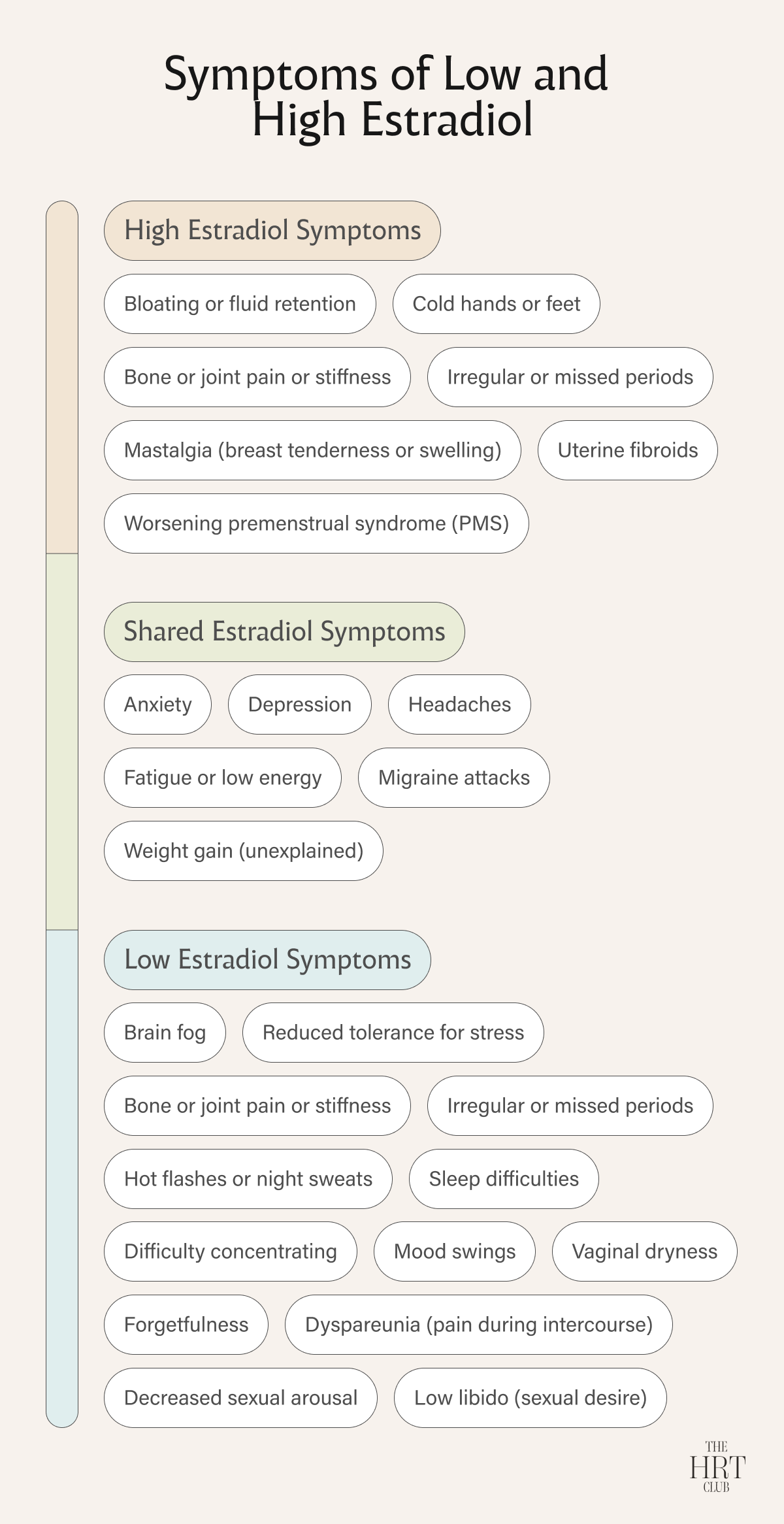
Symptoms of low estradiol
The following are potential symptoms of low estradiol, though these can also be symptoms of many other conditions.
“If a woman is experiencing symptoms that are impacting her daily life,” Dr. Patel says, “it’s worth having a conversation with a healthcare provider. The symptoms themselves are often just as important as the lab values.”
Physical symptoms
- Bone or joint pain or stiffness
- Fatigue or low energy
- Irregular or missed periods
- Headaches
- Hot flashes or night sweats
- Migraine attacks that increase in frequency or worsen over time
- Sleep difficulties
- Increased abdominal fat distribution or changes in body composition
Cognitive or emotional symptoms
- Anxiety
- Brain fog
- Depression
- Difficulty concentrating
- Forgetfulness
- Mood swings
- Reduced tolerance for stress
Sexual health symptoms
- Dyspareunia (pain during intercourse)
- Decreased sexual arousal
- Low libido (sexual desire)
- Vaginal dryness
What Do High Estadiol Levels Mean?
Just as a low estradiol level can raise red flags, so can a high result. But keep in mind that estradiol undergoes two rises over the course of the menstrual cycle.
Possible causes of high estradiol, not related to usual fluctuations:
- Certain medications
- Chronic alcohol use
- Estrogen-producing tumors outside the ovaries (rare)
- Fertility treatments
- Functional ovarian cysts
- Granulosa cell tumor (rare)
- Hormonal contraceptives
- Hormone replacement therapy (HRT)
- Hyperthyroidism
- Insulin resistance (when severe)
- Liver disease or dysfunction
- Obesity or excess weight
- Pituitary disorders
- Polyendocrine metabolic ovarian syndrome (PMOS), formerly called PCOS
Potential symptoms of high estradiol
- Anxiety
- Bloating or fluid retention
- Depression
- Fatigue or low energy
- Headaches
- Irregular menstrual cycle or breakthrough bleeding/spotting
- Mastalgia (breast tenderness or swelling)
- Migraine attacks
- Uterine fibroids
- Weight gain (unexplained)
- Worsening premenstrual syndrome (PMS)
You might be thinking, Hey, aren’t some of these symptoms the same as for low estradiol? And you are correct.
“Like many hormones, balance matters,” Dr. Patel says. “Estradiol that is too high, relative to a person’s individual needs, can contribute to symptoms.”
Why Perimenopause Makes Estradiol Levels Especially Hard to Interpret
If you’re in perimenopause, or suspect that you are because you’re having symptoms related to this midlife transition, you might be wondering why getting a reliable estradiol level is so complicated.
During the menopause transition, estradiol levels don’t take a steep cliff dive, nor do they gradually dissipate like air deflating from a tire with a slow leak. Instead, several factors contribute to wild fluctuations.
The menstrual cycle occurs along the hypothalamic-pituitary gonadal (HPG) axis. This means that your brain’s hypothalamus and pituitary gland communicate with your gonads (ovaries) in a feedback loop. The secretion of one hormone signals the release of another, and so on.
The menopause transition leads to several hormonal changes that disrupt this usual signaling, messing with the domino effect. In the journal Obstetrics and Gynecology Clinics of North America, researchers describe what’s called the luteal-out-of-phase (LOOP) cycle. The short explanation is that your cycle gets a bit “loopy,” meaning it is no longer consistent with typical phase patterns.
Now for the longer answer: Follicles in the ovaries are fluid-filled sacs where eggs mature during the follicular phase. But during perimenopause, they begin to mature early, during the luteal phase, before you even begin a new cycle. This head start on maturation, which results from an increasing level of follicle-stimulating hormone (FSH), means you have an early follicular recruitment resulting in an additional rise in estradiol.
So instead of having one estradiol peak at ovulation followed by a light dip and a gentle rise, you might experience two peaks and two gentle rises all in one cycle. If you happen to get your hormones tested at either of these peaks or gentle rises, they might look within range or even high.
“One of the biggest misconceptions about hormone testing,” Dr. Patel says, “is that a single lab value tells the whole story. During perimenopause, estradiol levels can fluctuate dramatically from day to day and even throughout the same menstrual cycle. A woman may have symptoms of hormone decline while still showing a ‘normal’ estradiol level on a particular day. That’s why we treat patients, not lab numbers.”
How Do You Get Your Estradiol Levels Tested?
Your provider can order an estradiol (E2) blood test if you need your levels tested. They can recommend when to get tested based on your cycle (if you still have one) and other factors. And they can recommend additional hormone tests if necessary.
Keep in mind that testing estradiol to diagnose perimenopause or menopause is generally not useful, because the results are so hard to interpret, according to research published in the journal Menopause.
“Estradiol levels become unpredictable up to 10 years prior to menopause in this perimenopause time,” Dr. Patel says. “It is a roller coaster between estrogen excess and deficiency, leading to mixed symptoms between too much and too little estrogen.”
However, testing may be warranted leading up to perimenopause to confirm or rule out other conditions that might be causing your symptoms.
If you undergo an estradiol test:
- Use the reference ranges for the lab that evaluated your blood sample, not a generic table or chart.
- If you still have a menstrual cycle, note the day in your cycle that you received your test and which phase you’re in.
- Know that a single test is just a snapshot in time, not a complete picture.
What Estradiol Monitoring Looks Like on HRT
Routine estradiol monitoring is not recommended for most people receiving menopausal hormone therapy. In selected situations, clinicians may measure estradiol levels to evaluate absorption, adherence, or investigate persistent symptoms.
The type of HRT you use, the method of delivery, and more impact test results, so “normal” ranges with HRT may be different than “normal” ranges without.
If you’re exploring HRT, The HRT Club can help you understand your options, find a qualified prescriber, and access FDA-approved hormone therapies with no insurance required. Learn more or sign up for a free membership
The Bottom Line
Estradiol is your most potent and abundant form of estrogen during your reproductive years. Your estradiol level fluctuates across the phases of your menstrual cycle and your life stages. Both unusually low and unusually high estradiol levels may be associated with symptoms depending on the underlying cause.
Test results only reflect a snapshot in time and do not give you the complete hormonal picture, nor are they useful for diagnosing perimenopause or menopause. However, your provider may test your estradiol for specific reasons, including if you are on HRT.
FAQ
What should a 40-year-old woman’s estradiol be?
The normal estradiol level for a 40-year-old female depends on menstrual cycle phase and life stage.
Why are my estradiol levels so low even though I’m not in menopause?
In people approaching menopause, perimenopause is a common cause of fluctuating and sometimes low estradiol levels. In younger individuals, other causes should also be considered.
Do GLP-1s affect estrogen?
The short answer is no, GLP-1 medications like Ozempic, Wegovy, Mounjaro, and Zepbound don’t directly influence estrogen. Instead, they mimic a gut hormone that regulates blood sugar, slows digestion, and signals fullness to the brain. However, GLP-1s may indirectly affect estrogen in a few ways. Substantial weight loss may reduce peripheral estrogen production in postmenopausal women, although the clinical significance varies. Additionally, individuals who experience metabolic dysfunction may have high insulin levels that suppress estrogen production; GLP-1s can help improve insulin sensitivity and subsequently restore estrogen levels. According to a recent study, those seeking weight loss after menopause may actually see more success when combining HRT and GLP-1 medication.