.png)



Key takeaways:
- Low estrogen symptoms include, but are not limited to, hot flashes, low sex drive, brain fog, weight gain, mood swings, low mood, sleep disruptions, and fatigue.
- Sustained estrogen dips can have far-reaching effects on health, often impacting someone’s quality of life and potentially leading to long-term health risks without treatment.
- Many cases of low estrogen can improve with appropriate treatment. This may include lifestyle changes, nutritional modifications, hormone replacement therapy, or a mix of these options.
Conversational takeaway: It would be so nice if our health came with an owner's manual, complete with official diagnoses and treatment plans. Instead, it’s normal to experience symptoms that could stem from multiple conditions, leaving us with a lot of guesswork and uncertainty about which healthcare provider to see first. Conditions that cause low estrogen are no exception. While that fabled user’s guide doesn’t exist, this article may help you better understand low estrogen symptoms and what to do if experiencing any.
Low estrogen symptoms probably bring to mind hot flashes, sleep disturbances, and irregular periods. While these are potential symptoms of low estrogen, they could be related to other conditions too. To add more fuel to the confusion fire, conditions that cause low estrogen may come with unexpected symptoms as well, such as fatigue, anxiety, and bladder leaks.
To help connect the dots between what you’re experiencing, here’s some of the most common symptoms of low estrogen, what causes them (hint: menopause is a big one but not the only cause), and what your next steps might be if experiencing any.
The role estrogen plays in your body
We often think about estrogen as the “female sex hormone,” but there’s more to it than that. Estrogen interacts with a lot of different biological systems, making it essential to both women and men (and yes, you read that right; men have estrogen too!).
“Estrogen acts like a master communicator throughout the body,” says Betsy Greenleaf, DO, a board-certified OB/GYN, “It affects the brain, heart, bones, muscles, skin, urinary tract, vagina, metabolism, and even the microbiome.” That means estrogen plays a role in the regulation of mood, cognition, sleep, pain perception, and other functions that contribute to overall well-being.
What are the symptoms of low estrogen?
Just like estrogen is a social butterfly in the body, the signs of low estrogen in women and others cover a lot of ground. They may include physical, cognitive, emotional, and sexual symptoms.
As you read over the specific symptoms, you’ll notice some overlap with the signs of other health conditions. That’s why it’s important to get an official diagnosis instead of self-diagnosing low estrogen.
Physical symptoms
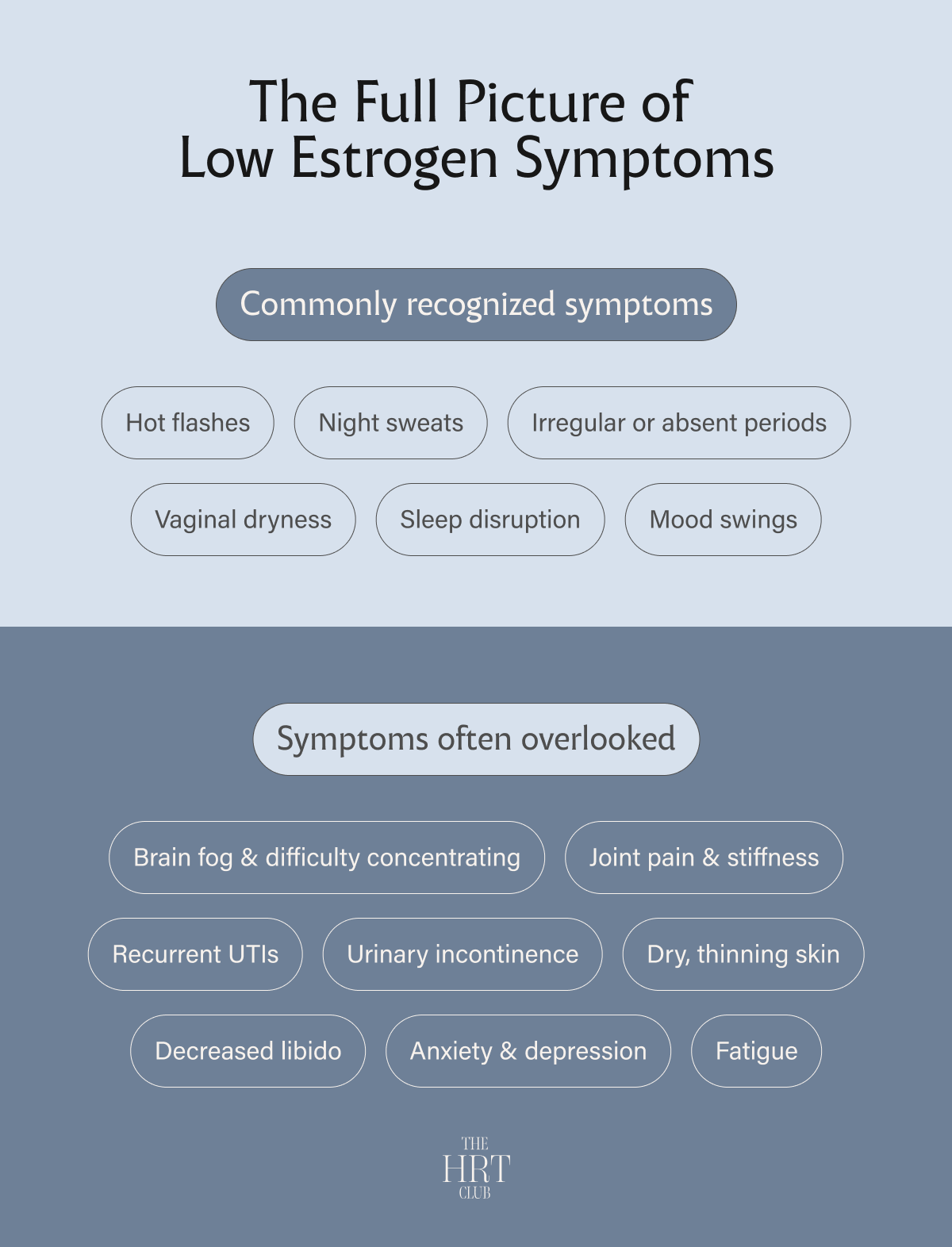
When we think of menopause and other causes of low estrogen, certain physical symptoms come to mind. You know the ones—the irregular periods, difficulty falling or staying asleep, and vasomotor symptoms like hot flashes and night sweats.
But these aren’t the only physical symptoms. Dr. Greenleaf says patients are often surprised at what symptoms may stem from low estrogen and reminds us that estrogen affects many different biological processes.
According to the National Institute of Aging, other low estrogen physical symptoms include:
- More urinary tract infections (UTIs) than before
- Dry skin
- Thinning hair
- Fatigue
- Muscle discomfort
- Joint pain
- Urinary incontinence
- Weight changes, especially weight gain around the stomach
- Loss of muscle mass
Cognitive and emotional symptoms
“Reproductive hormones like estrogen provide a foundational scaffolding for mental health,” says Susan Zink, MD, a psychiatrist who specializes in women's mental health, “When estrogen fluctuates and declines, the brain may have trouble adapting.”
According to a 2025 study in Advances in Therapy, people with low estrogen report a variety of cognitive and emotional symptoms:
- Mood swings
- Irritability
- Anxious thoughts (and an increased risk of developing anxiety)
- Low mood (with a higher chance of developing depression)
- Memory difficulties or lapses
- Trouble concentrating
- Brain fog
- A decrease in motivation
- Low confidence or self-worth
Sexual health symptoms
Some sexual health symptoms may readily come to mind as low estrogen symptoms (looking at you vaginal dryness, painful intercourse, and low sex drive). But there are others we don’t talk about as often.
People with low estrogen may experience vaginal and vulvar irritation, including burning and itching, a tight vaginal opening, or light bleeding after sex, per the National Institute on Aging.
These symptoms stem from what’s known as vaginal atrophy. This is when the vaginal walls change, often thinning, becoming inflamed, or becoming dry, due to low estrogen supply, according to Harvard Health. It’s the phenomenon behind most sexual health symptoms in women, including the ones above.
Low estrogen health risks
Low estrogen symptoms have a huge impact on the day-to-day, but when levels remain low, they increase long-term health risks too:
- Bone density loss: Perhaps the most established long-term health risk is osteoporosis. A 2022 article in the International Journal of Molecular Science defines osteoporosis as a condition where bones are weak and susceptible to breaking or fractures. Even those who don’t have osteoporosis experience significant bone density loss within five years of reaching menopause, per a 2025 study in Calcified Tissue International.
- Cardiovascular risk: Estrogen offers a protective element for heart health. A 2021 review in Oxford Medicine and Cellular Longevity found an association between lower estrogen levels and a higher risk of heart disease.
- Cognitive health: The evidence here is still developing, but a 2023 review in Cureus suggests an association between estrogen deficiency and Alzheimer’s disease and dementia.
What causes low estrogen?
If perimenopause/menopause was your first guess, you’re spot-on. The time leading up to the final period, and menopause, when someone goes 12 months without a period.
Perimenopause is a long transition, with estrogen dips along the way. Once someone hits menopause, estrogen levels remain lower than before. But while this transition is a common cause of low estrogen, it’s not the only potential culprit.
A more complete list of causes includes:
Premature ovarian insufficiency (POI)
When the ovaries stop working before the age of 40, per the National Library of Medicine. This is different from premature menopause because people with POI still have irregular periods.
Hypothalamic amenorrhea
The absence of menstruation (and dipping of estrogen) due to a disruption in the hypothalamus, the part of the brain responsible for regulating the menstrual cycle, according to Harvard Health.
Surgical menopause
If someone must have a surgery to remove their ovaries, the procedure may induce what’s known as surgical menopause, per the National Cancer Institute. This is when menopause comes early as a result of a surgery.
Chemotherapy or radiation
The National Cancer Institute also states that both radiation therapy and chemotherapy may disrupt hormonal health, resulting in lower estrogen levels.
Thyroid disorders
The thyroid is a butterfly-shaped gland that produces hormones. While it doesn’t produce estrogen, thyroid hormones help regulate the female reproductive system, per the Journal of Midlife Health. When someone has a thyroid disorder that disrupts thyroid hormone production, it may have a ripple effect on estrogen too.
How providers evaluate low estrogen
If you’re experiencing the symptoms above and a healthcare provider suspects an estrogen deficiency, they may order an estrogen levels test. The National Library of Medicine walks us through this test.
First, the patient provides either a sample of blood, urine, or saliva (spit). The healthcare provider will determine the right sample type.
Once a lab has that sample, they’ll analyze the estrogen levels in it. There isn’t a “normal” estrogen range per se because “normal” depends on your age, gender, and type of estrogen measured.
And because those of us who are biologically female experience variable estrogen levels, thanks in part to menstruation and to how hormones naturally fluctuate during puberty, pregnancy, and menopause, a healthcare provider may order multiple tests. This captures estrogen trends over time versus levels at a specific moment.
While these tests provide important data, they are not diagnostic on their own. A healthcare provider interprets them alongside symptoms, cycle changes, age, and a patient’s medical history.
While it’s a-ok to go to a primary care provider first, they will probably refer you to a specialist, such as a gynecologist or other hormonal health provider to determine if low estrogen is the cause.
Alternatively, if you already work with a gynecologist, you may be able to make an appointment directly with them. Membership platforms, like The HRT Club, also offers access to a directory of HRT experts.
When do low estrogen symptoms warrant treatment?
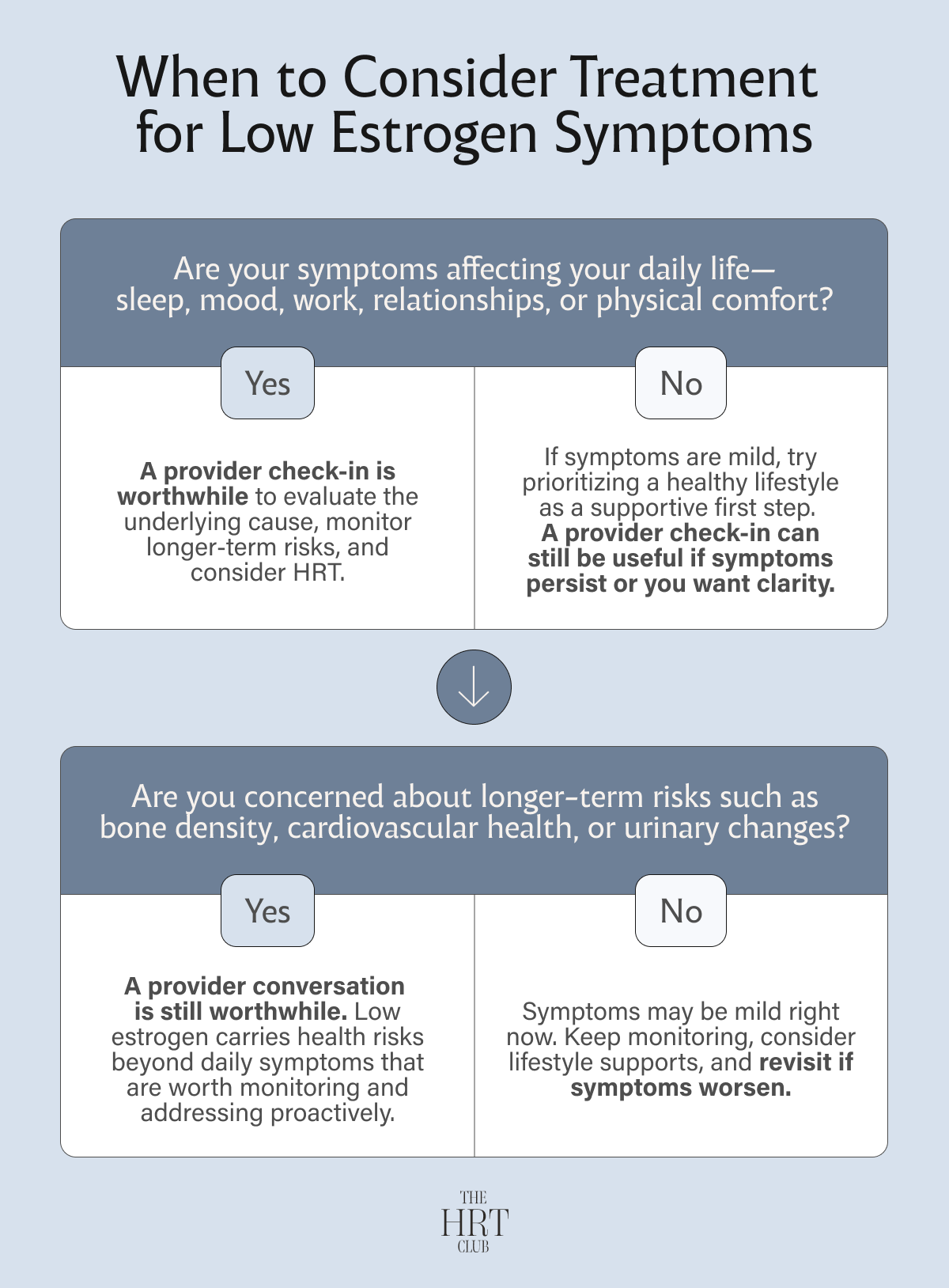
If you find yourself powering through symptoms, working for hours with a headache, or completing a morning workout with flu-like symptoms, know that the threshold for when low estrogen symptoms warrant treatment is probably lower than you expected. As soon as symptoms affect quality of life, work, sleep, sexual health, or relationships, explore diagnosis and treatment options, recommends Greenleaf. Here’s exactly what getting help might look like for mild, moderate, and severe symptoms.
Mild symptoms
Mild symptoms are noticeable but not significantly disruptive to sleep, work, relationships, or everyday life. It’s worth repeating that if you notice symptoms, you deserve relief, even if you can tolerate them. “I encourage women not to dismiss symptoms simply because they are common,” says Dr. Greenleaf, “Just because something is common doesn’t mean it should be ignored.”
When symptoms are mild, lifestyle changes (detailed in the next section) may be suitable. While many of these are DIY-friendly, it’s still worth having a conversation with a provider to confirm low estrogen actually is the cause.
Moderate symptoms
Low estrogen symptoms in women are considered “moderate” when they disrupt sleep, mood, relationships, or work performance. When symptoms become disruptive, see a healthcare provider to confirm the underlying cause and discuss treatment options, which may include hormone replacement therapy.
Severe symptoms
Severe symptoms significantly affect quality of life on a daily basis. This could look like brain fog that makes it impossible to focus on work for more than a half hour or joint pain that makes it hard to get out of bed.
When symptoms are severe, make that appointment with a healthcare provider ASAP. They can confirm the underlying cause and if it is low estrogen, hormone therapy may be an appropriate treatment option.
Treatment options for low estrogen
Once a healthcare provider confirms low estrogen is the cause, they’ll create an appropriate treatment plan, which may include hormone replacement therapy, lifestyle changes, diet, supplements, or a mix of the above.
Hormone replacement therapy (HRT)
The name gives away the basics of how this treatment works: HRT replaces hormones with low levels, such as estrogen. Currently, HRT is FDA-approved for relieving severe vasomotor symptoms of low estrogen and preventing osteoporosis. HRT is available in several forms, including patches, gels/sprays, vaginal rings, creams, tablets/inserts, and injections.
For some people, HRT leads to significant changes in sleep, mood, and other symptoms, says Dr. Zink, but not everyone is a good candidate for HRT. “The decision should be made collaboratively with a physician who understands both the benefits and the risks, and who takes the woman’s individual circumstances and preferences seriously,” she explains.
To learn about HRT options, check out The HRT Club. This membership platform is committed to helping people with low estrogen access hormonal health experts and affordable treatment options.
HRT safety callout box: Whether HRT is appropriate or not depends on the specific condition, overall hormonal health, formulation, timing, and individual risk factors, all of which will be assessed by a prescribing healthcare provider. HRT should not be used if you have a history of a hormone-positive breast cancer unless cleared by your oncologist.
Lifestyle changes
Lifestyle changes are part of the treatment plan for many health conditions, including those that cause low estrogen.
The following habits can be standalone treatments for mild symptoms or may complement medical treatment in moderate-to-severe cases:
- Regular exercise: Movement matters enormously, says Dr. Zink. This could look like going for daily walks, running a few times a week, or practicing yoga. In a 2025 study in Telemedicine Reports, people in perimenopause experienced fewer emotional and physical symptoms of low estrogen after completing a 12 week program where they walked for at least thirty minutes five or more days a week.
- Strength training: Ok, this is technically part of exercise, but it deserves its own bullet because building muscle is so important if experiencing low estrogen. “Prioritizing resistance training is one of the most powerful interventions because it helps preserve muscle mass, bone density, metabolic health, and insulin sensitivity,” says Dr. Greenleaf. And that doesn’t mean you have to spend every free moment in the gym. A 2026 study in the British Journal of Sports Medicine suggests 60-119 minutes of strength training a week is the sweet spot.
- Stress management: “Chronic stress can amplify many symptoms associated with hormone fluctuations,” explains Dr. Greenleaf, “Supporting the nervous system is often an overlooked but important piece of the puzzle.” This may look like a daily meditation or breathwork, though the Journal of American College Health suggests even recreational reading may work.
- Sleep hygiene: People who menstruate are 1.5 times as likely to have insomnia, per a review in the Journal of the Endocrine Society. That risk often peaks near midlife and is associated with low estrogen levels. Practicing good sleep hygiene can play a role in improving how long you’re asleep (and sleep quality). The CDC lists a few good habits: waking up and going to sleep at the same time, sleeping in a quiet, cool space, and avoiding caffeine in the afternoons.
Diet and supplements
When estrogen levels dip, some plant-based foods can provide a lift. More specifically, phytoestrogens, metabolites found in these foods that are similar in structure to estrogen, may interact similarly with estrogen receptors as the naturally occurring estrogen, per Frontiers in Endocrinology. However, phytoestrogen should be used as a supportive dietary component, not a treatment substitute.
The U.S. Department of Veterans Affairs provides a list of foods with phytoestrogens:
- Lentils
- Legumes
- Soy
- Flaxseed
- Brussels sprouts
- Sunflower seeds
- Red clover
And red clover segues into supplements, which are a dicey topic. Some people believe supplements with black cohosh or red clover help with low estrogen symptoms, though the National Center for Complementary and Integrative Health points out that more research is necessary to confirm the effects of these supplements. And over-the-counter supplements are far less regulated than prescription medications.
Keep in mind as well that phytoestrogens aren’t a cure-all. They’re part of a healthy, balanced diet. Dr. Greenleaf mentions that a nutrient-dense diet full of fiber, protein, colorful vegetables, omega-3 fatty acids, and, yes, phytoestrogen-rich foods are often the best nutritional plan to support hormonal health, a claim that’s backed by a 2025 article in Frontiers in Aging.
The bottom line
Low estrogen symptoms are far-reaching and merit medical attention. If you’re experiencing any of the symptoms above, contact a healthcare provider who can help diagnose the underlying cause and recommend solutions. Effective treatment options include hormone replacement therapy, lifestyle changes, and diet modifications. If looking to explore hormone therapy options, The HRT Club is a great place to start your search.
FAQ
What happens if your estrogen level is too low?
In the short-term, the signs of low estrogen include physical symptoms, like hot flashes and dry skin, cognitive symptoms, such as mood changes or brain fog, and sexual health symptoms, like vaginal dryness or low sex drive. If low levels are sustained, it may increase the risk of conditions like heart disease, osteoporosis, and urinary tract changes.
Can you have low estrogen in your 30s?
It’s possible to have low estrogen at any age. If someone in their 30s has low estrogen, possible causes include primary ovarian insufficiency, premature menopause, hypothalamic amenorrhea, and some thyroid disorders. Undergoing chemotherapy or exposure to radiation may also cause levels to dip.
What are the symptoms of low estrogen in men?
Low estrogen symptoms in men may include hot flashes, impaired cognitive function, weak bones, fatigue, and increased belly fat. If levels remain low, the risk of cardiovascular disease, insulin resistance, and osteoporosis will increase.
About Author