.png)
.jpg)



Key takeaways:
- The menopause transition and beyond causes hormonal changes that can affect metabolism and lead to weight gain.
- Strength training and increasing protein and fiber intake are key strategies to address these changes.
- Hormone replacement therapy (HRT) can also help by boosting levels of estrogen and progesterone, which play roles in how your body manages nutrients and energy.
Maybe this scenario feels familiar: You reached your mid-40s and, suddenly, almost nothing you do to manage weight seems to work anymore. You feel frustrated at the thought of having to buy new clothes because of a changing body shape.
And the fact that you also feel itchy, achy, and hot then cold, along with numerous other sensations and a roller coaster of emotions, isn’t helping one iota. Whew. Menopause is a lot, isn’t it? You’re certainly not alone in the experience.
Although many of the symptoms you’re experiencing are frustrating to say the least, body composition or weight changes can be particularly vexing. This is especially true if you see a doctor who dismisses your concerns and tells you to just “exercise more and eat less”—as if you haven’t already tried that. The truth is that what’s going on isn’t about some personal failure on your part. Menopausal and perimenopausal weight loss can be challenging.
“One of the biggest myths I hear from women is, ‘I must be doing something wrong because nothing works anymore,’” says Betsy Greenleaf, DO, the founder of The International Pause Institute. “Menopausal weight gain rarely has anything to do with willpower. It is often the result of multiple physiologic changes occurring simultaneously.”
Weight and body composition changes are a completely normal part of the menopause transition and beyond, but that doesn’t mean they aren’t frustrating experiences.
The good news is that you’re not at the mercy of menopause. Understanding why weight and body composition change during this phase of life can help you address them. But before we dig in, we want to make clear that weight changes are completely normal during this time. By the way, not all weight gain is the same. Gaining weight, especially if it’s muscle, is a good thing.
We’re not here to encourage the unsustainable “thinspo” ideals that social media sometimes touts. “The goal is not necessarily to be smaller,” Dr. Greenleaf adds. “The goal is to be stronger, healthier, and more metabolically resilient.”
In this article, we explore why weight and body composition may change as part of menopause, how to lose weight during menopause if that’s your goal, and more.
Why menopause makes weight loss harder
Menopause complicates weight management because of the hormonal shifts that affect various factors related to your metabolism and your overall metabolic health.
- Metabolism: All the chemical reactions your body uses to convert nutrients into energy.
- Metabolic health: How efficiently your body creates and uses energy.
Diet and exercise efforts that served you well in your 20s and 30s tend to be less effective once you enter the menopause transition. We cover these hormonal changes and how they affect weight and body composition below. But first we unpack the terminology, which can get a bit confusing.
Menopause-related terms:
- Premenopause: You’re in your reproductive years before you enter perimenopause.
- Perimenopause: Your hormones have started shifting as your ovarian reserve (how many eggs you have left in your ovaries) declines. This often starts in your 40s, though it can occur earlier. Perimenopause is often called the menopause transition and lasts until menopause.
- Menopause: You’ve had an absence of a period for a full year. The average age in the United States is about 52, though menopause can occur earlier, according to the National Institute on Aging.
- Postmenopause: Once you reach menopause, a moment in time, you’re essentially in postmenopause for the rest of your life.
Estrogen and weight
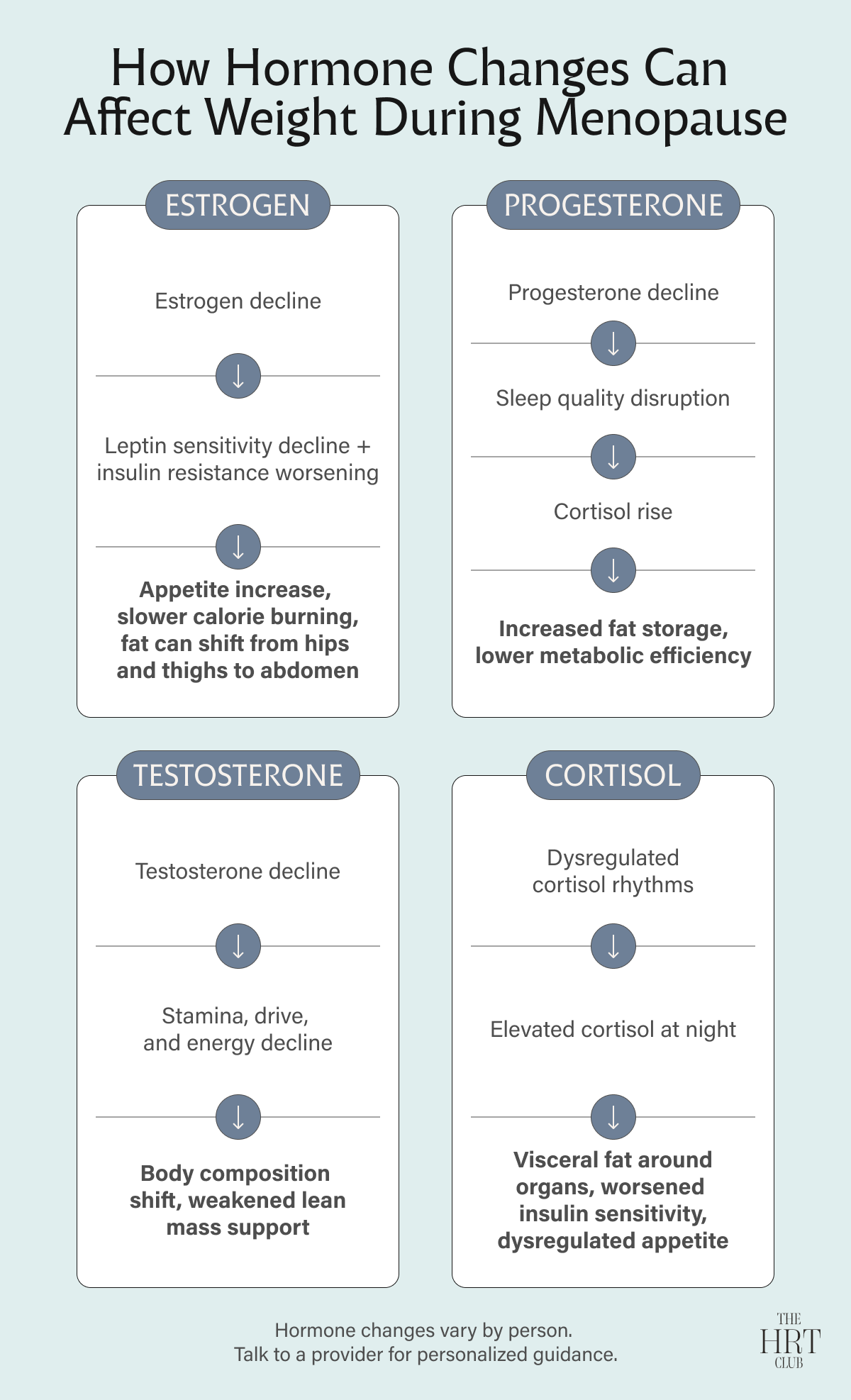
By the time you reach menopause, your estrogen levels may have declined by about 50% compared to your reproductive years, according to research in the Journal of Clinical Endocrinology & Metabolism.
Estrogen loss is one of the key players in why body shape may change during menopause. This is because estrogen plays an important role in fat distribution, insulin sensitivity, and muscle maintenance through several mechanisms. We cover these here, but don’t worry, we got you: Later in the article, we share what you can actually do to address weight gain.
Fat gain
Estrogen aids with fat oxidation (how much fat you burn) and how much energy (calories) you burn overall. So a loss of estrogen decreases your overall energy expenditure, including while you sleep, according to research in the International Journal of Obesity.
Research also shows that estrogen loss may lead to fat gain. It may increase both subcutaneous fat (the kind just under the skin) and visceral fat (which surrounds internal organs). Your body needs both types of fat, to be clear, but too much visceral fat increases your risk for type 2 diabetes, cardiovascular disease, and other chronic health issues. Overall, menopause is associated with a 3% increase in body fat, according to research in the American Journal of Obstetrics and Gynecology. Menopause hormonal changes may also alter body shape, shifting fat storage from thighs and buttocks to the abdomen.
What’s behind the increase in visceral fat? Increases in cortisol (the “stress hormone”) likely contribute. The loss of estrogen and progesterone (discussed below) can disrupt your hypothalamic-pituitary-adrenal (HPA) axis, which controls your stress response, according to research in the journal Frontiers in Global Women’s Health. Chronic stress can lead to higher cortisol levels over time, and cortisol may contribute to visceral fat gain by causing higher blood sugar levels and insulin resistance.
Muscle loss
In addition to fat gain, estrogen loss can also lead to muscle loss. Everyone is already at risk for losing lean mass in middle age and beyond—at least without strength training in the mix. But menopause accelerates the loss of this valuable tissue because estrogen aids with muscle gain and maintenance. Compared to people in early menopause, those who are postmenopausal have 10% lower lean muscle mass, according to the journal Bone.
Obviously, we need some brawn to heft grocery bags, shovel snow, and do all manner of other everyday activities. But muscle is also protective of insulin resistance, a topic we discuss below. And muscle mass is also important for your metabolism, according to research in the journal Molecular Research in Obesity Related Disorders.
“With less muscle mass, fewer calories are burned at rest, as muscle tissue is one of the most metabolically active tissues in the body,” Dr. Greenleaf says. “This also accounts for the fact that many women find that the very same diet and exercise program that worked for them in their 30s suddenly stops working in their 40s and 50s.”
Increased insulin resistance
In addition to preserving muscle, estrogen is also protective against insulin resistance, according to The American Journal of Pathology. Insulin is a hormone produced in your pancreas. It enters your bloodstream in response to eating. Insulin resistance means your cells have stopped responding as well to insulin’s signals to uptake glucose (blood sugar) from the bloodstream.
Insulin resistance leads to increased fasting glucose and insulin levels and is a key risk factor for developing type 2 diabetes. Higher insulin levels are associated with weight gain, according to the journal Diabetes/Metabolism Research Reviews.
Insulin resistance also affects metabolic flexibility, how efficiently your body toggles between burning glucose and fats for energy based on its needs. Reduced metabolic flexibility is associated with weight gain, according to research in the journal Cell Metabolism.
Increased leptin resistance
Estrogen is also protective against leptin resistance, notes the journal Obesity Medicine. Leptin is a hormone produced in fat cells. It communicates to your brain that you’re full or satisfied from a meal, which then suppresses your appetite. A loss of estrogen can lead to leptin resistance. Leptin resistance occurs when your brain has become desensitized to this signal, leading to issues with appetite control, which can contribute to weight gain.
Progesterone and weight
Progesterone also declines as part of the menopause trajectory. In fact, it usually is the first to start a descent, before estrogen levels careen, according to research in the journal Frontiers in Bioscience-Scholar. Progesterone loss alone may not contribute to weight changes, but when coupled with estrogen loss, weight management may become more difficult.
Increased fluid retention
If you’re feeling more bloated during perimenopause or beyond, you’re not imagining it. Progesterone helps you excrete sodium by competing with aldosterone, a hormone that encourages sodium and water retention, according to the journal Cardiovascular Endocrinology & Metabolism. When progesterone levels decrease, aldosterone wins the battle, leading to bloating or swelling and excess water weight.
Reduced sleep quality
Wherever you are on the menopause trajectory, we probably don’t have to tell you that this midlife change can also disrupt your sleep. Perhaps you’re lying in a set of sweaty sheets right now, trying to understand why you can’t nod off or stay that way. Progesterone acts a bit like a sedative, and it also helps calm anxiety, according to research in the Journal of Sleep Disorders and Therapy. So when your natural levels drop, you can experience sleep disturbances.
Poor sleep can also make you more insulin resistant the next day, according to the journal Cureus. It also decreases leptin (the hormone that tells your brain you’re full) and increases ghrelin, a hormone that tells your brain you’re hungry, notes research in the journal Nutrients. Poor sleep can lead to weight gain through these mechanisms.
Testosterone and body composition
The female body also has circulating testosterone, a hormone that plays roles in supporting muscle mass and energy levels, among other things, according to The British Journal of General Practice.
Testosterone may fluctuate during perimenopause, depending on various individualized factors. But typically it declines by about 50% just before menopause, according to the journal The Lancet Healthy Longevity. However, more research is needed on exactly what happens to testosterone levels throughout the menopause trajectory and how these changes might affect weight.
What actually works: Evidence-based strategies for menopause weight loss
Now that we’ve explored what causes weight and body composition changes during menopause, you might be wondering how to lose menopause weight. Many people undergoing the menopause transition now, or who are in postmenopause, grew up during a time when much was missing from research on body composition.
Older diet and exercise advice championed low-calorie diets and exercise to burn calories. However, body composition and weight are not about simple math. As we just outlined above, complex hormonal processes also affect weight and fat distribution, according to the International Journal of Molecular Science.
“When I’m working with a woman who’s gaining weight during menopause,” Dr. Greenleaf says, “I’m looking at a lot more than calories in and calories out. Because all of these systems are interconnected, I am looking at hormones, muscle mass, sleep, stress, inflammation, gut health, and lifestyle factors.”
Newer research suggests that the following strategies are more effective than focusing on calorie counts.
Resistance training: The most important exercise change
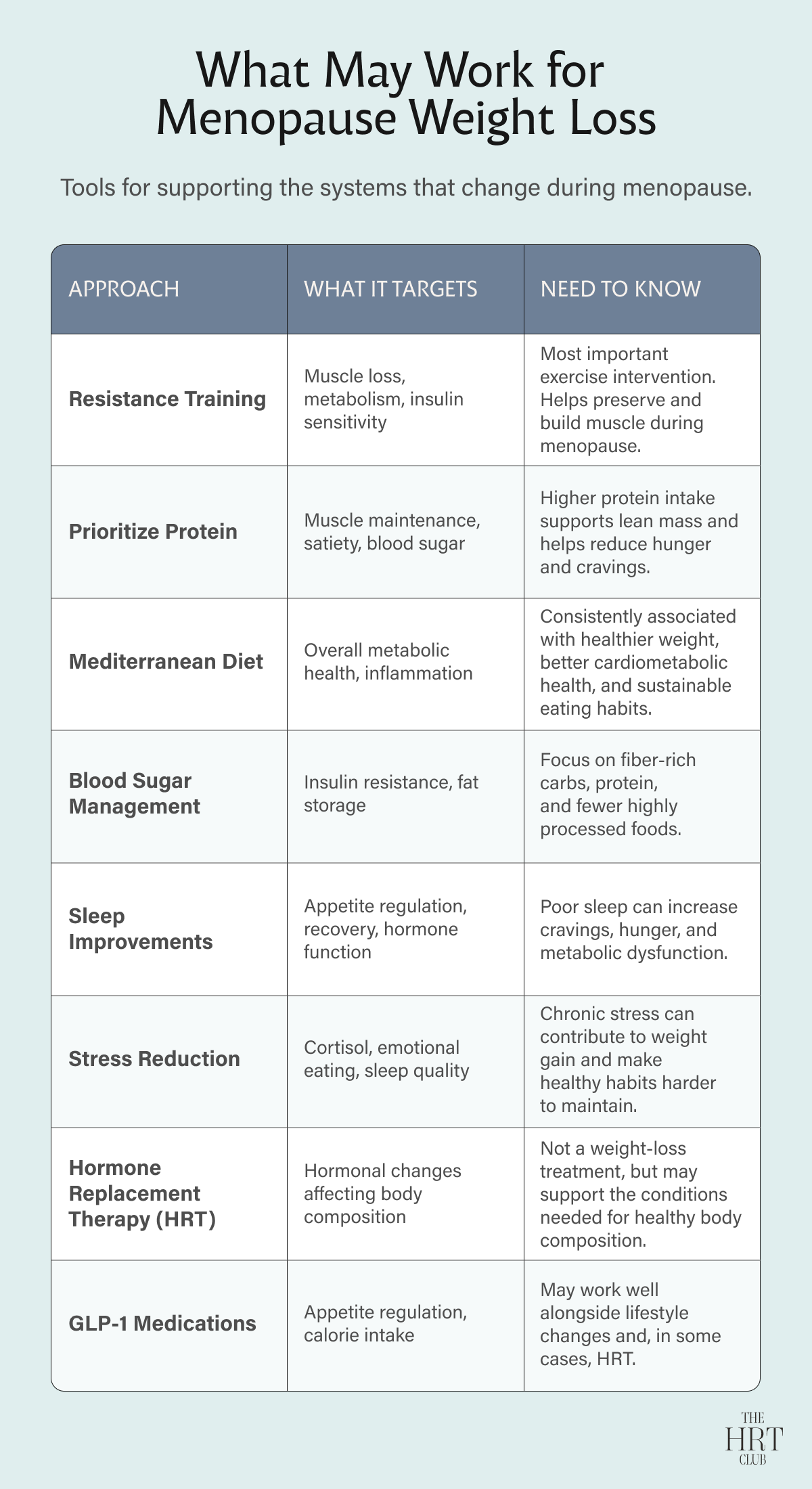
Resistance training includes lifting weights (whether using free weights or gym machines) or doing body-weight exercises, such as push-ups, squats, and more. As noted above, you lose muscle mass as hormones shift in midlife. Resistance training helps you preserve and even build muscle. Lean mass gains help rev your metabolism and increase insulin sensitivity (the opposite of insulin resistance).
“Many women spend hours doing cardio,” Dr. Greenleaf says, “because they want to lose weight, but it’s strength training that helps preserve and build muscle. Muscle is the engine for metabolism, and as hormones decline, it is more important to maintain it.”
Cardiovascular exercise is still crucial for heart and mental health, but aim to get at least two days of strength training per week on your schedule, in keeping with recommendations from the Centers for Disease Control and Prevention (CDC) and other health agencies and organizations.
One more note on strength training. It helps lead to what’s called body “recomposition,” reducing fat gain while increasing muscle. Muscle tissue is denser than fat tissue, meaning it takes up less space. So gaining muscle may help you reach your goals without changing the number on the scale all that much. Or you might even see it increase while your clothes actually fit better.
Protein: Why protein requirements increase
To build and maintain lean mass, your body needs adequate protein. Protein also helps slow the absorption of glucose into your bloodstream, keeping blood sugar levels in check, which helps you maintain insulin sensitivity, according to research in the journal Frontiers in Nutrition. Additionally, protein helps you feel more satisfied from your meals and snacks.
“It helps women feel fuller for longer and reduces cravings that may come with hormonal fluctuations,” Dr. Greenleaf says.
A good rule of thumb is to aim for about 1 gram of protein per pound of ideal body weight, notes the journal Food and Function. That said, your protein needs will vary based on your body size, activity level, goals, and medical history, and people with kidney disease or other conditions should check with a clinician or dietitian.
Diet: What the evidence actually supports
In addition to eating more protein, a few additional changes to your diet can be beneficial.
Reduce sugar and processed carbohydrates
Meals or snacks that are high in sugar or processed carbohydrates can increase insulin resistance and drive weight gain. This doesn’t mean you have to completely eliminate sugar or eat a low-carbohydrate diet. Your body needs carbohydrates. Instead, focus on carbohydrates that contain fiber. And pair your carbohydrates with protein.
Increase fiber
Fiber is a type of carbohydrate, but your body doesn’t digest it. Fiber can blunt glucose response and instead feeds the beneficial microbes in your gut that then produce short-chain fatty acids (SCFAs). SCFAs stimulate the production of glucagon-like peptide-1 (GLP-1) hormone, which has beneficial effects on insulin sensitivity and appetite control, according to the journal Microbiology Insights. Like protein, fiber also helps you feel more satisfied from your meals and snacks.
Reduce intake of ultra-processed foods
Ultra-processed foods (UPFs) are those that bear little resemblance to their natural states and contain considerable amounts of food additives. Additives include artificial sweeteners and added sugar, chemical preservatives, and sodium. Some additives (and the food’s packaging) may contain endocrine-disrupting chemicals that can disrupt hormonal processes and contribute to obesity, according to the Journal of Xenobiotics.
You don’t have to completely eliminate UPFs, but reducing them can support your body composition goals.
Sleep, stress relief and mental health: Not just wellness
As noted above, menopause can lead to a lack of quality sleep and an increase in stress. Prioritizing good quality sleep is essential. If you’re experiencing sleep difficulties, talk to a menopause-informed clinician who can help. Additionally, work on ways to reduce stress. Exercise is an effective way to counteract stress and improve sleep, according to research published in the journal Cureus.
“Menopause often takes place at a very busy and demanding time in a woman’s life,” Dr. Greenleaf adds. “Many women are juggling children, aging parents, careers, relationships, and trying to keep themselves healthy all at the same time.”
If you are experiencing increased stress, anxiety, or depression, never hesitate to talk to a mental health professional who can offer guidance.
Hormone replacement therapy (HRT): What it can and can’t do for menopause weight loss
Hormone replacement therapy (HRT) helps boost levels of key hormones (usually estrogen and progesterone) during menopause and beyond.
“I tell my patients all the time,” Dr. Greenleaf says, “hormone replacement therapy is not a weight-loss therapy. But it can assist in recreating the physiologic environment needed for healthy body composition.”
She adds, “When the hormones are dialed in, many women notice better sleep, more energy, better exercise recovery, better mood, better insulin sensitivity, and just an overall better sense of well-being. Those improvements often make it easier to do the lifestyle habits that help support weight management.”
For people with a uterus, systemic estrogen is generally paired with a progestogen to help protect the uterine lining. Estrogen causes endometrium (uterine lining) growth, which increases the risk for endometrial hyperplasia (overgrowth), potentially leading to cancer, according to the Journal of Clinical Medicine.
What about testosterone? The U.S. Food and Drug Administration has not approved any testosterone replacement therapies for the female body. However, some testosterone treatments are prescribed off-label, according to the Journal of Personal Medicine. Prescribing something off-label means that a drug that’s FDA approved for a condition is prescribed to treat an unapproved use.
HRT + GLP-1: An emerging combination worth knowing about
The new class of weight-loss medications called GLP-1 receptor agonists might also be on your radar. Maybe you’re wondering whether one of these medications in combination with HRT can help.
Emerging research (one small study, published in the journal Menopause) included 16 people in post-menopause. Researchers found that a combination of HRT and semaglutide (sold under the brand names Ozempic and Wegovy) led to a higher percentage of weight loss over three months when compared to only taking a GLP-1. Still, with such a small sample size, more research needs to be done, so discuss with your provider before making any combinations.
The bottom line
“The future of menopause medicine isn’t just about helping women lose weight,” Dr. Greenleaf says. “It’s helping them preserve muscle, optimize hormones, reduce inflammation, support the microbiome, increase resilience to stress, and create long-term metabolic health.”
If you’re considering HRT or already have a prescription, The HRT Club can help you access affordable FDA-approved hormone therapies without relying on insurance or a traditional pharmacy. Members can save up to 90% compared to retail pharmacy cash prices.
FAQ
What exercise is best for menopause belly fat?
Both strength training and cardiovascular exercise can help you lose overall body fat, but there’s no one way to spot-reduce menopause-related belly fat specifically. Building muscle in general is a great goal, though, as it boosts your metabolism — while cardiovascular exercise can help lower cortisol levels. Cortisol is one contributor to visceral fat that can push the belly out.
What is the best menopause diet to lose weight?
No single diet is best to counteract weight gain associated with menopause. However, adding more protein and fiber to your diet can help you feel more satisfied from your meals, reduce cravings, and stabilize blood sugar and insulin levels—all of which can help you reach your weight loss goals.
Can GLP-1 medications help with menopause weight gain?
Yes, GLP-1 medications may help eligible patients with weight management, and early research is exploring whether HRT may influence response in postmenopausal women.