.png)
.jpg)



Key takeaways:
- The cost of hormone replacement therapy (HRT) to alleviate menopause symptoms varies from $0 to 500+.
- The cost range is so wide because pricing depends on health plan coverage and details, the type of medication, the delivery method, and more.
- You can use certain strategies to lower the cost for more affordable HRT.
If you’re in the throes of the menopause transition or on the other side of it, you might have a prescription in hand for hormone replacement therapy (HRT) and you might be wondering what filling it will do to your bank balance. Or maybe you may have been filling an HRT prescription for a while now and are looking for ways to reduce your costs.
The monthly cost of HRT varies based on many factors, including your health insurance coverage status, the type of HRT and delivery method (e.g., pills, patches, creams, etc.), and more.
Understandably, the process of getting an HRT prescription and figuring out how to pay for it can be frustrating, especially at a time when you’re going through bodily changes that can also highly impact your quality of life.
In this article, we explore hormone replacement therapy cost based on type and your insurance status, and we provide strategies for lowering what you pay out of pocket.
How Much Does Hormone Replacement Therapy (HRT) Cost Per Month?
HRT costs range from $0 to $80 with insurance and from $10 to $500 or more without insurance.
What you pay will depend on whether you have insurance and your plan’s details, the HRT type and delivery method, whether you use any discounts or coupons, and more.
The ranges below are intended as per-month cash/out-of-pocket price estimates (without insurance). But doses vary by prescription, which may change the price. Insurance can lower costs substantially if it covers it. But formulary tier placement, deductibles, prior authorization, and copays mean “covered” does not always mean inexpensive. A medication that costs little with one plan may still carry a high copay or coinsurance under another. Or, in some cases, insurance may not cover HRT.
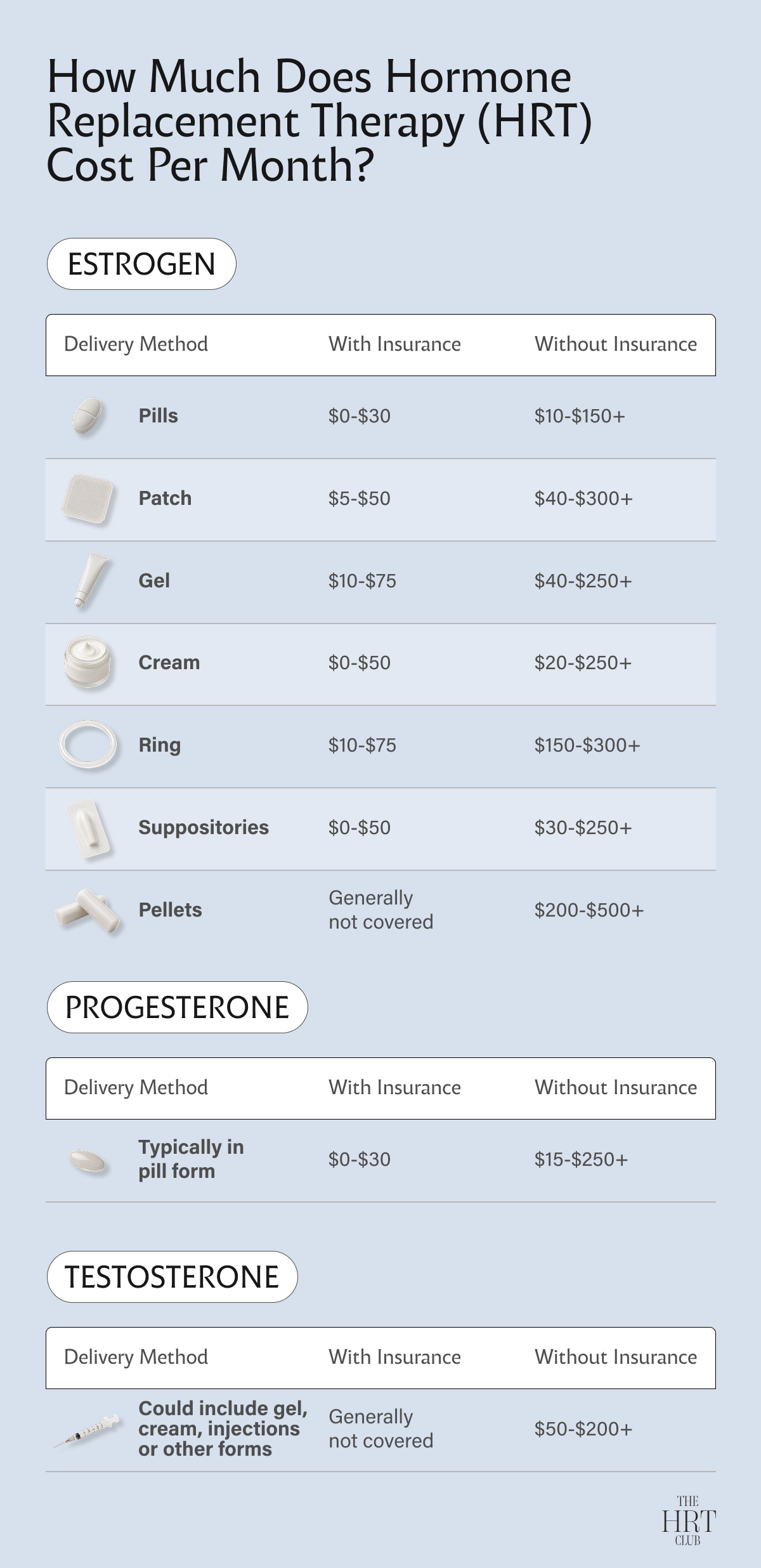
Now we’ll explore these HRT prices more in depth below.
A note on hormones: If you still have a uterus and are taking HRT, you will need to take progesterone in addition to estradiol (aka estrogen). This is because, without progesterone to oppose estrogen, estrogen can cause an overgrowth of the uterine lining, which can increase your risk for uterine cancer.
A note on terms: Some HRT formulations are compounded by pharmacies. These are not approved by the Food and Drug Administration (FDA). This means they may not be covered by insurance. FDA-approved medications are usually the preferred option when available and clinically appropriate. However, compounded medications may be appropriate in specific cases.
Estrogen pills
Estrogen in capsule or tablet form is among the most common and most affordable forms of HRT. You take estrogen pills by mouth, usually once per day. Estrogen pills are not recommended for people who have a history of blood clots. This is because your liver must metabolize estrogen taken orally, which can increase the production of clotting factors.
Estrogen cost (pills) per month:
- With insurance: $0 to $30
- Without insurance: $10 to $150+
Estrogen patches
Estrogen patches deliver transdermal estrogen (through the skin). You apply an estrogen patch once or twice a week to your buttocks or lower abdomen. Transdermal delivery does not pass through the liver, so it may be a safer option for people with a history of blood clots. But you should consult your provider. Some people with skin sensitivities or allergies may develop a rash or irritation from patch adhesives.
Estrogen cost (patch) per month:
- With insurance: $5 to $50
- Without insurance: $40 to $300+
Estrogen gels
You apply a topical estrogen gel directly to your skin once daily. Follow your product’s directions, but common sites are the shoulders, arms, or thighs. Gels are another transdermal option that may be safer for people with a history of blood clots. Additionally, gels may be a good patch alternative if adhesives cause you irritation.
Estrogen cost (gel) per month:
- With insurance: $10 to $75 per month
- Without insurance: $40 to $250+
Vaginal estrogen creams
You apply a vaginal estrogen cream using an applicator inserted into your vagina. Other types of estrogen (i.e., pills, patches, and gels) are systemic options, meaning they treat overall menopause symptoms. Vaginal estrogen creams, on the other hand, are localized treatments and are not intended to treat systemic issues, such as hot flashes.
Instead, vaginal estrogen creams treat genitourinary (genital and urinary) symptoms of menopause. These include vaginal dryness or itching, pain with intercourse, urinary frequency and urgency, some types of incontinence, painful urination, recurrent urinary tract infections, and more.
Vaginal creams may also be an option for people with a history of blood clots, but talk to your provider.
Estrogen cost (cream) per month:
- With insurance: $0 to $50
- Without insurance: $20 to $250+
Vaginal rings
Vaginal estrogen rings are a circle of flexible material that you insert into your vagina. They release estrogen over time. You replace the ring at scheduled intervals based on your product’s directions. Some rings can stay in place for up to 90 days. Depending on their formulation, rings may be intended for localized or systemic treatment.
Vaginal rings may also be an option for people with a history of blood clots, but talk to your provider.
Estrogen cost (ring) per month:
- With insurance: $10 to $75
- Without insurance: $150 to $300+
Vaginal suppositories
You insert a vaginal suppository (or insert) into your vagina using an applicator at regular intervals, depending on the product’s specifications. Like estrogen creams, vaginal suppositories deliver estrogen locally to treat genitourinary symptoms of menopause. They are not systemic treatments.
Vaginal suppositories may also be an option for people with a history of blood clots, but talk to your provider.
Estrogen cost (suppositories) per month:
- With insurance: $0 to $50
- Without insurance: $30 to $250+
Pellets
Hormone pellets are small implants inserted under the skin via an in-clinic procedure. They release hormones over time.
Pellets are not approved by the FDA and are sold as “bioidentical hormones.” Insurance, therefore, typically does not cover this type of HRT.
Estrogen cost (pellets) per month:
- With insurance: Generally not covered
- Without insurance: $200 to $500+
Progesterone
Progesterone helps protect the uterine lining from exposure to excess estrogen. It is commonly prescribed along with estrogen therapy for this reason. Usually, progesterone is taken orally in pill form.
Progesterone cost per month:
- With insurance: $0 to $30
- Without insurance: $15 to $250+
Testosterone
The FDA has not approved testosterone products for treating menopause symptoms. However, sometimes providers prescribe this hormone off-label to address a low sex drive. Products include gels, creams, injections, and pharmacy-compounded formulations.
Testosterone cost per month:
- With insurance: Generally not covered
- Without insurance: $50 to $200+
What Affects the Cost of HRT?
As you can see, HRT costs vary dramatically, which can be frustrating. All you might want to know is what you will pay out of pocket. Here are the main factors that affect cost.
- Generic vs. brand-name medications: Even though brand names and their corresponding generics contain the same active ingredients, they may have different inactive ingredients, which can lead to a different experience., They can also have dramatically different price points.
- Delivery method: HRT is delivered in many different ways, from pills to vaginal rings and more. Pills and topicals tend to be the most affordable.
- Insurance tier placement: If HRT is in Tier 2 or Tier 3 of your formulary, you may have a higher copay and coinsurance.
- Pharmacy: The same prescription can vary by $50 to $100 or more, depending on where you get it filled.
- Discount options: Manufacturer savings cards, prescription discount cards, and more may help lower your HRT costs.
Does Insurance Cover HRT?
The good news is that most health insurance plans cover HRT for menopause. But coverage doesn’t automatically mean that HRT is fully covered or affordable.
“The costs of HRT vary because insurance coverage is so different between different companies,” says Jerrold Weinberg, MD, FACOG, the director of the Birmingham Menopause Institute and the author of Menopause Mended.
What “covered” actually means
Coverage does not mean that a medication is free or low cost. You may have to pay a copay and coinsurance, out-of-pocket fees.
Your plan places medications in what are called formulary tiers. Tier 1 (the lowest tier) medications will be the most affordable because they have the lowest associated copays and coinsurance.
“The biggest driver in HRT cost is how a drug is listed on a plan’s formulary,” says Danielle K. Roberts, a Medicare expert and cofounder of Boomer Benefits. “Some plans may classify it on a low tier with small copays or low coinsurance. If it’s non-preferred or requires prior authorization, people can certainly expect higher medication costs.”
Prior authorization requirements
Some insurance plans require prior authorization for menopause HRT. This means your plan requires your provider to prove that the medication is medically necessary for you. If you are denied coverage, you have the right to appeal the decision.
Medicaid and Medicare coverage
Medicare and Medicaid generally cover menopause HRT as long as your provider shows that the medication is medically necessary for you.
Medicaid coverage for menopause HRT varies by state. You can check your state’s Preferred Drug List (PDL) to find out which generics and brands are covered.
"Medicare ends up playing a key role in how people access and afford hormone replacement therapy, since menopause can end up lining up with Medicare eligibility,” Roberts says. “For Medicare Part D, each plan can treat HRT coverage differently, so the same medication can be fully covered on one plan and cost more on another.”
She adds, “Plan formularies and coverage can change year to year, so choosing a Part D plan that properly covers the specific HRT medication can have a bigger financial impact than most people think.”
What about compounded HRT?
Most health insurance plans do not cover compounded HRT because the formulations lack FDA approval.
What Are the Other Costs of HRT?
The cost of the medication is just one component of the total cost of HRT. Other elements include the following:
- Initial provider consultation: To receive your HRT prescription, you will need to see a prescribing provider. They will evaluate your symptoms, medical history, and more to determine if HRT is right for you and in what forms.
- Lab work: Your provider may need to do lab work, usually a blood panel, to check your hormone levels. This is especially true if you’re considering testosterone HRT. You may need to repeat this panel for the most accurate representation, since hormone levels fluctuate.
- Follow-up visits and ongoing monitoring: Even after you’ve been taking HRT regularly, you will need to follow up with your provider for monitoring. How often this is required will depend on your unique circumstances and provider preferences.
How to Lower Your HRT Costs
Now that you know what HRT might cost you, you might be wondering about ways to lower what you pay out of pocket. Here are some strategies.
- 1. Ask for the generic prescription: Generics are typically Tier 1 formulas, so if your insurance plan covers HRT, a generic option will be the most affordable.
- 2. Use manufacturer savings cards and patient assistance programs: Check your medication manufacturer’s website. They may have a patient assistance program that covers all or part of the medication or they may offer a card that helps lower your copay.
- 3. Use a prescription discount tool: These tools are free to use and can help lower the cash price of a medication. (However, pharmacies are not required to honor them.) Options include:
- GoodRX
- SingleCare
- Optum Perks
- ScriptSave WellRx
- 4. Compare pharmacy prices: Check your medication’s price with your regular pharmacy. Then compare prices with competing pharmacies.
- 5. Transfer your prescription: If you find a lower price point elsewhere, transfer your prescription.
You can also consider a telehealth service, which may help streamline the process while also potentially lowering total care costs.
Or check out The HRT Club, a consumer platform that charges members an annual fee to buy FDA-approved HRT online without going through health insurance or a traditional pharmacy. Members save up to 90% compared to retail pharmacy cash prices.
The Bottom Line
The cost of HRT to address menopause symptoms varies dramatically. Cost depends on insurance plan coverage and details, the type of medication you need and the delivery method, and more.
But you can take steps to lower the cost of HRT by opting for generic medications, using manufacturer coupons or patient assistance programs, trying prescription discount tools, and comparing prices across pharmacies. Additionally, The HRT Club helps you bypass health insurance plan and pharmacy hiccups.
FAQ
Why is HRT so expensive, even with insurance
HRT can be expensive even if your health insurance plan covers your medication. Plans also typically have copays and coinsurance for prescriptions, fees you pay out of pocket. The formulary tier your plan designates for your HRT medication will determine how much you pay at checkout.
Can I transfer my HRT prescription to a different pharmacy?
Yes, you can transfer your estrogen or progesterone HRT prescription to a different pharmacy. Contact your new pharmacy and ask them to contact your previous one. Testosterone is a Schedule III controlled substance and cannot be transferred using the standard pharmacy-to-pharmacy method. Instead, you can contact your provider and ask them to send a new prescription to your new pharmacy.
Is compounded HRT covered by insurance?
Compounded HRT is not FDA-approved and is therefore generally not covered by insurance.